
VALUE: After Hours (S07 E38): Small and microcap investor Adam Wilk on coal $NRP, furniture $LEFUF and fire systems $APG
Sunday, November 2, 2025 · Johnny Hopkins
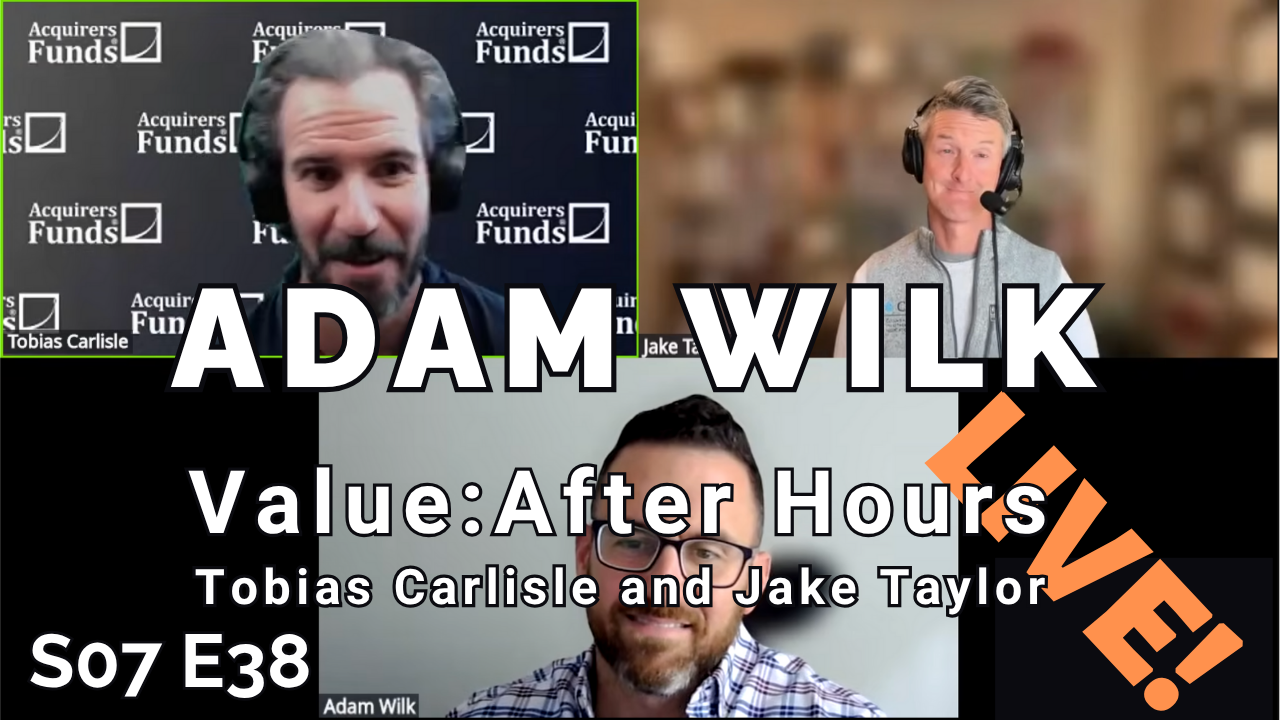
During their recent episode, Taylor, Carlisle, and Adam Wilk discussed:
- Leon’s Furniture: Canada’s Durable Retail Giant
- APi Group (APG): A Hidden Leader in Fire and Life Safety Services
- The Chipmunk Analogy: Reputation, Risk, and Survival
- Small Cap Investing and Lessons from Scouting
- Greystone Capital’s Investment Philosophy
- Case Study: Natural Resource Partners (NRP)
- Understanding Coal Pricing and Industry Discipline
- The Broader Energy Narrative and Misperceptions
- Beyond Commodities: Portfolio Overview
You can find out more about the VALUE: After Hours Podcast here – VALUE: After Hours Podcast. You can also listen to the podcast on your favorite podcast platforms here:

 Breaker

 Overcast


 RadioPublic


 Stitcher

TRANSCRIPT
Tobias: I think we’re live.
Jake: [laughs] It’s always a question.
Tobias: This is Value: After Hours. I’m Tobias Carlisle, joined as always by my cohost, Jake Taylor. Our special guest today is Adam Wilk. He’s a small and micro investor at Greystone Value. Welcome Adam, how are you?
Adam: Thanks a lot. Thanks for having me. Doing great.
Tobias: So, tell us a little bit about Greystone Value, your investment strategy there, what you’re looking for.
Greystone Capital’s Investment Philosophy
Adam: Sure. Yeah. The high-level pitch is I formed Greystone Capital as a separate accounts business about five years ago with just myself as the CIO and PM, and now have some outsourced back-office partners. My background includes time spent in the NBA working for the Spurs and Rockets as a scout and analytics employee in the front office. And then, I have a few years of credit experience as a senior commercial lender for a large bank.
I launched Greystone. We just passed the five-year mark, and we’ve done about 24% net during that time, outpacing both the Russell Microcap S&P. A chunk of the firm is my capital which we’ve now transitioned to a fund structure after five years of running separate accounts. My and all of my family’s net worth is invested in the strategy.
As you mentioned, we are long only microcap to midcap focused, I would say, at this point and really looking for good businesses, good management teams and cheap valuations. Ideally, what I’m trying to find, is that set up with businesses in transition. Not so much turnarounds, but situations where normalized earnings power is not being recognized or valued appropriately.
Typically, when I find those situations, we concentrate into larger positions with our top five holdings making up somewhere between 65%, 70% of the portfolio. The opportunity set as we were talking about before we started is very good for the strategy right now, and I think there’s some really interesting situations that attract evaluations that I’m seeing almost on a weekly basis.
Tobias: Can you walk us through, if not a name, then just a case study, maybe something that you’ve closed out?
Adam: Something that I closed out?
Tobias: Either something that you hold, if you’re happy to talk about that, or something that you closed out if you prefer not to talk about stuff you hold.
Case Study: Natural Resource Partners (NRP)
Adam: Yeah, sure, I’m happy to talk about something we own. A couple of our largest positions I think fit the bill there, one of which I can’t talk about, because I’m still actively buying, but I think fits the bill perfectly. But another one is a company called Natural Resource Partners. The ticker is NRP. They’re a coal royalty business, and they own 13 million acres of mineral rights in various parts of the US. They lease out that acreage to various coal producers. They also own a soda ash mine in another part of the US, that is also leased out to operators. They do some carbon capture work on their land as well.
NRP is interesting, because they’re a royalty business, they don’t actually mine the coal themselves, so they have very limited ongoing operating expenses and no capital expenditures. So, the business does about 90% free cash flow margins. It’s very easy to understand, as mentioned, the company just leases out their acreage to producers under long-term leases between 5 and 40 years with minimum royalty payments guaranteed. They are paid on a price per ton of coal mined.
They have two types of coal that’s being mined on their properties. Thermal coal, which is used for electricity generation, and met coal, which is used in the process of steel making. It’s pretty widely known that thermal coal is in decline, especially in the US, as a source of power generation or electricity generation.
NRP is a big exporter for thermal coal outside of the US, but the majority of their volumes, about 70% and revenues come from met coal, which has no replacement, and is used in the process of making virgin steel, which is used for roads and construction and bridges and infrastructure. And over time, I’d imagine that percentage creeps up as thermal coal is phased out.
But what makes NRP interesting is not only the fundamental profile, but where it fits that business in transition, is that leading up to 2017, the prior management team had a difficult time, I think, just sitting on their butt and collecting cash from the royalty business. And so, they went out and made a number of acquisitions that both bloated the asset base and didn’t contribute to profitability, and they took on a lot of debt to do so.
And then, during 2015, 2016, excuse me, when the price of coal declined significantly, NRP got themselves into some trouble, and they were bailed out by some distressed debt firms, and they had to take on some onerous preferred stock and warrants, and they replaced the CEO at the time. Ever since that time period, they’ve been maniacally focused on paying down debts.
By my calculations they have about 12 months or less, maybe one year worth of free cash flow of debt on their balance sheet, at which point they’ll have a net cash balance sheet, and they’re going to take all of the cash flow that the business generates and return it back to shareholders.
At today’s price, you’re getting a cash flow amounts to somewhere between a 15% to 16% return or yield on the current valuation. NRP is at $1.3-billion market cap. Normalized cash flow is somewhere between $200 million and $250 million. They also have the distinction of operating in an industry that is hated by investors and capital markets alike. And so, you’re purchasing NRP today at a single digit multiple of cash flow and getting that return profile back in 12 months or less.
I think what happens is twofold. One, the stock will likely rerate once the distribution becomes set in stone and likely rerate to maybe where traditional or typical MLPs trade which is somewhere between, I would say, a 7% to 10% dividend yields, maybe a little bit lower because the business is higher quality. And then, you have the optionality to get–Sorry. You’re also getting the cash flow back and recovering your cost basis within five to seven years with an optionality on everything they earn after that.
The industry dynamic, the fact that the capital hasn’t started being distributed yet and it could also come in the form of buybacks and then the fact that NRP is an MLP, so it’s a master-limited partnership I think has deterred a lot of investors. But to me, the interesting part of the investment thesis is when you stress test NRP, which the company has undergone significant stress over the last decade plus and has remained free cash flow positive throughout that entire period, so in a variety of coal price environments.
What makes that interesting today, is that, because their interest expense is lower because they’ve been paying down debt, their unlevered free cash flow profile is way higher. We’re probably around a floor price for met coal today and thermal. You can make the argument in either direction, but– And we can get into the specifics of that. But even in the event that coal prices decline, NRP will still be able to generate significant amounts of free cash flow. And so, it’s a very durable, resilient, asymmetric setup that is unloved by the market and being overlooked just given the industry, and some of the things we discussed that I think– If you’re able to look out the next three, five, seven years, it gets very, very interesting. It’s not apples to apples, but along the lines of a Texas specific land sort of situation.
Jake: So, Adam, what would NRP– If it was an NBA player, who would it be?
Adam: Oh man, that’s putting me on the spot here.
Jake: Yeah.
Adam: That’s a great question.
[laughter]Adam: Maybe Robert Horry or Udonis Haslem.
Jake: Okay.
Adam: I’m saying that because of the durability or-
Jake: [crosstalk]. Yeah.
Adam: -a lot of capability. There are multiple things they can do, going to last a really long time, a veteran in the industry. So, that’s my lame take on answering that question.
Jake: Rehabbing from a knee injury.
Adam: Sure. Yeah, exactly.
[laughter]Tobias: Hey, walk us through the expected pricing of met coal and thermal coal. I’m just interested to hear how you think about it.
Understanding Coal Pricing and Industry Discipline
Adam: Yeah, sure. So, what’s interesting about NRP in my view, is that you’re taking as little price risk as possible. Pardon me. If you own a producer, obviously, there’s significant operating leverage there that can work against you or work for you. If coal prices decline and the top line goes down with a producer you have nasty operating leverage that can hit the bottom line pretty significantly. NRP is not exposed to any of that, because as mentioned, they’re a royalty business.
When you’re trying to invest in the commodity space, at least what I’ve learned is you want to try to take as little price risk as possible by investing in trophy assets. The way that you can determine when you have a trophy asset is by looking at two things among some others. One is the what is a break even cost of the commodity for that business. So, in the example of coal, at what price point are you able to break even as a producer? That part of the trophy asset description doesn’t fit NRP, because they’re not a producer, so they don’t have to worry about price risk there.
But the other part of that is what’s the reserve life index? That is you take your current production levels and you divide it by the amount of reserves that you have in the ground. And in NRP case, the reserve life index is between 30 and 40 years, if not longer. And so, you have a significantly long runway for them to continue to lease out their properties to various operators where they can collect royalties on the coal mine. Even if the price of coal goes down significantly– I’ve stress tested this business to the point of looking at 50% drawdowns in the price of coal, which setting aside the unknown effects of that industry wide would have the effect of shutting down basically the entire industry.
NRP is still guaranteed somewhere between $60 million, $65 million in minimum royalty payments per year. These payments have been stress tested through lessee bankruptcies and all kinds of adverse business scenarios. And so, that $60 million on the current market cap I think amounts to somewhere between a 4% to 5% free cash flow yield. And again, that’s in a scenario that I view is very low probability. And so, you can just see how you’re taking very limited price risk here.
Having said that, we are probably at trough levels for at least met coal pricing moving forward. There’s a really good case to be made that prices can increase significantly as we head toward the latter half of the decade. After COVID, most producers’ costs went up due to labor inflation and some other factors, and so that naturally puts a floor on met coal prices.
I guess Economics 101 would tell us that mining below the marginal cost of production is uneconomical, and it’s better to just shut a mine down in that situation.
We’ve already seen not so much a wave, but some with industry wide we’ve seen some bankruptcies and shutdowns and that sort of thing on the smaller mine side. But because everybody’s cost structure has gone up, because the supply-demand imbalance in the industry is so severe, there’s a really good case to be made at– Using the PLV index as a measure, this 185, 190 price that we’re at today is a trough for the industry.
The other interesting part about just looking industry wide, if you study some commodity industries today, I feel this way about oil and gas a bit. Canadian oil sands, coal, etc., these guys have obviously long histories of booms and busts. So, when prices are high, they spend a ton of money, they take on debt to do so and they just drill– Baby drill is the phrase. It’s happened in oil and gas, it’s happened in coal.
Jake: Oh, sorry, you were talking about computer chips there for a second.
[laughter]Adam: Yeah. So, for the past decade plus, there’s been a political shift toward cleaner sources of energy and removing carbon emissions from the environment. Rightfully so, I think we all want a greener, cleaner planet moving forward. But what that’s done is that’s reduced investment in both oil and gas and in the coal industry, coal specifically. And so, these producers, the ones that are scaled and left over, have realized that they no longer can rely on capital markets or external funding. They basically have to control their own destiny. What that’s done is that’s caused them to develop an extreme financial discipline that we have never seen before in the industry.
If you read the annual reports or the investor presentations and you listen to a lot of the producers speak these days, all of their commentary is around a lack of spending, but just generating cash flow, growing free cash flow per share, returns on capital, returning capital to shareholders. It’s like unheard of. It’s like, “Am I reading about the coal industry or is this something else?”
Again, I feel that way with oil and gas, too. I think one of the reasons Buffett bought Oxy, if I’m not mistaken, is because they basically said, “We’re not going to spend a ton of money drilling for new wells. We’re just going to take the majority of our cash flow and we’re going to return it to shareholders,” and I think it amounts to almost a double-digit yield between dividends and buybacks.
It’s very similar in the coal industry. You can find a lot of these producers saying and doing the same things. Alpha Metallurgical Resources, a very large met coal business has retired 30%, 40% of their share count in the last five years. They went crazy after COVID with the buybacks. And so, the industry has changed a lot, and that’s caused the producers to just manage the current supply or capacity that they have, knowing that you can’t get a permit for a new mine, especially in the US. There’re no new coal plants being built on the met coal side, we’re really probably just depleting the current capacity.
So, all of those things put together, I think make it so that because of that supply demand imbalance, there’s a really good case to be made that prices will go up from here. And if they don’t, I think the investment still fares fairly well. Like I said, the downside is quite protected. So, I think it’s a very interesting and asymmetric bet here. The industry has changed a lot, which I think will aid in the investment case moving forward.
The Broader Energy Narrative and Misperceptions
Tobias: If you’re small and micro and value these days, it’s inevitable that you have some exposure to coal– Met coal is probably is obviously the better place to be. Is the met coal price depressed because of cheap steel? Do you think is that why China’s able to produce steel very cheaply? All the steel producers in the US are trading really cheaply as well. Is it a demand issue for the steel that’s driving the met coal price?
Adam: Yeah, it’s that and there’s a bit of oversupply now, just because demand is down and stockpiles are a little bit higher than they have been in the last few years. The biggest countries that drive demand across the world are China and India. India’s demand has been fairly stable, and the world has actually used record amounts of coal in 2023, 2024, and now, we’re on pace for a record in 2025 as well.
So, number one, the narrative that coal is going away is simply not true, or at least not proven out yet. But number two, China’s economy is a big driver of both steel demand and coal demand. And so, with the setbacks that they’ve had both in the property sector and real estate, that I think drives a lot of activity, broadly speaking, and has a big effect on the price.
And so, those are probably the main explanations now.
And then, there’s always other little things that happen throughout the year, whether it’s some new countries emerge as some incremental suppliers with incremental capacity or there’s natural disasters and that sorts of things. So, I think the scale of pricing and supply and demand can go up and down on a yearly basis, but broadly speaking, I think the world will continue to use more and more coal over the next 3, 5, 10 years, etc. Yeah, so, I think it’s driven by a couple of things.
Jake: It is interesting to think that China’s cars are effectively coal powered. Just you have an EV battery in between there.
Adam: Yeah, very interesting. The narratives out there surround– I’m not an expert. I’m a generalist, do your own work and don’t take what I say verbatim. But the narratives out there about energy and coal usage and trying to get to zero carbon emissions by 2050, I think are just that. At this point, they’re narratives and they’re not really based in reality, given what I’ve discovered.
To reach a point where we eliminate all fossil fuels within two decades is unfortunately a pipe dream, and would constitute probably the largest and most expensive project ever undertaken by our civilization to do it that quickly. And so, given the way politics moves and the steps we’ve taken so far, it doesn’t seem likely.
Sometimes those narratives get a hold of investment themes or certain industries, and they stick around for a while. I’m not saying coal businesses are the greatest business in the world, but when you do have an industry shift and a misperception and a lot of value there, I think if you just look across the sector, that’s very interesting to somebody like myself.
I certainly wouldn’t start my search for companies in commodities or in energy, but this is a new space for me. I spent a lot of time on it the last year and a half and so. I like learning about new businesses and sometimes you get an insight here or there that I think leads to something good. And so, yeah, trying to work through the narrative has been interesting about where we are and I think it’s opened up some opportunities, to be honest.
Beyond Commodities: Portfolio Overview
Tobias: What other things do you hold besides? Do you have any exposure to things outside of commodities?
Adam: Yeah, the portfolio is really unique today. It’s made up of very individually bottomed up opportunities and companies that I find interesting and that I like, etc. I have exposure to some retail on the e-commerce side. I own a furniture retailer which we can discuss. There’s fire safety and life safety business, so a niche industrial, although that’s a larger company. There’s a company in the portfolio that operates a portfolio of hospitals. I’ve got nonprofit software, HVAC maintenance, and repair. So, a lot of different industries and companies. I think, again, the strategy is very bottom up and so–
There are some themes I think at a high level. I love service businesses, and I’m really looking for recurring service businesses with operating leverage, sometimes pricing power companies that have long runways for growth and that operate in some durable, or stable industry or niche where they can grow along with their end market over time. But broadly speaking, the portfolio is pretty unique today.
Leon’s Furniture: Canada’s Durable Retail Giant
Tobias: Can you walk us through the furniture?
Jake: That’s the one you pick?
[laughter]Adam: Absolutely. Yeah. No, it’s interesting. It’s interesting.
Tobias: I’ll tell you why I’m interested in furniture. Because I think that there’s a broader theme. There’s a housing and– I just want to hear in that context, but I don’t want to–
Jake: People like to sit.
Tobias: [chuckles] I don’t want to get in front of your thesis.
Adam: Everybody needs furniture, so we have– So, I wrote this company up, it’s called Leon’s Furniture. They’re the largest furniture retailer in Canada. I wrote the company up a few quarters ago or last year, I can’t remember, in one of my letters. And I compared it to Nebraska Furniture Mart. It’s definitely not apples to apples. NFM is significant. I think they do like a billion dollars out of their one store in Omaha, which is insane.
But Leon’s is very scaled. They’re the largest furniture retailer in Canada. They have 300 stores across the country, and they also have an e-commerce business. The furniture business is 100 years old. It was founded by an immigrant in the early 1900s. It’s gone through a few iterations as a business, but they acquired their largest competitor in 2013, which is like, I don’t want to say discount furniture, but on the lower end and Leon’s is in the mid-market, I guess range for furniture and pricing. And since then, they’ve grown their revenues and earnings per share pretty significantly.
If you look back over the last 10 years and 20 years, Leon’s is about as durable of a business, especially for a retailer that you could find. They’ve had zero years of unprofitability through all economic environments over the past 10 years and 20 years. They’re have just been excellent stewards of capital and really good operators.
The company’s 70% owned by the Leon family, who is a founding family obviously. The profile is basically they can grow somewhere between 3% to 5% every single year. They have the largest market share in Canada. They’re basically known as a big box store. They’re at about 15% or 17% market share. They dwarf their next largest competitor in terms of size.
Well, IKEA is their next largest competitor. So, they don’t dwarf IKEA, but outside of them and IKEA, their next largest competitor is multiples smaller than they are. And in Canada, if you study the history of big box retail like Loblaws, Canadian Tire, etc., these guys basically gobble up all the market share over time. I think Leon’s is headed in that direction.
What makes it interesting, is that in 2023, for the first time ever, they hired a non-family member CEO. And that guy since that time period has repurchased 10% of shares outstanding. He has paid out a significant amount of capital. He has grown the business significantly, and they just started instituting an IR presence. And so, I think Leon’s, despite being a $1.8 billion Canadian business, they’re fairly underfollowed and overlooked. I think it’s because they haven’t really spent a lot of time communicating with investors, which is about to change.
In fact, for Q3, they’re hosting their first conference call, I don’t think ever, but in a very long time. I think it will start to be a regular thing moving forward. But today, on that $1.8 billion market value, you’re getting a normalized $300 or so million of EBITDA and probably $200 million to $225 million in free cash flow. And that free cash flow can grow over time, especially, because as Leon scales or as they grow their revenues get bigger, there’s opportunities for margin expansion, just doing some internal initiative things and just getting larger. There’s also the opportunity for some M&A.
The furniture industry is going through some difficulties both in the US and in Canada. I think as their competitors go out of business, they can absorb that incremental market share which will again strengthen the business over time. The scale that Leon’s brings to the business means that they have some version of pricing power with their business. They are by far the largest advertiser in the country. They spend by my estimate, I think, over $100 million in advertising expense. They’re all over the place.
When times when things happen like COVID or supply chain issues or something like that, their scale still allows them to get inventory into the stores. As an example, they are the largest importer of shipping containers into the country of Canada. If you look at their margin profile over the last– And they have some boots on the ground in China, etc. And so, their cogs are remarkably durable and they can work through even adverse economic scenarios just given their scale. If you look at their margin history over a long period of time, you can see the stability of that as well.
I’m interested in the furniture business. One of their comps, a large furniture retailer called Sleep Country was sold in 2024 for, I think, around eight and a half times EBITDA and 18- or 19-times’ earnings. Sleep Country is the number one mattress retailer in Canada. They were bought by Fairfax. Leon’s trades at a mid-single digit multiple of EBITDA and 10-or-11 times earnings. It’s two times the size of Sleep Country. It’s a number two mattress retailer in Canada. They weren’t quite growing as fast, but their scale and market share dwarfs where Sleep Country was on their store count. And so, I think that’s an interesting comp, just as a single deal to look at.
I’m interested in the furniture business. I think it’s cheap, I think it has opportunities for growth. I think capital allocation has been excellent. I think it’s very durable. But there’s also this other angle where Leon’s through the decades has amassed this really valuable portfolio of real estate, including on their headquarters where they have a 40-acre lot that’s right off of the 401 or 410 Highway Downtown Toronto. I estimate this lot is alone is probably worth a few hundred million dollars. And their plan is to partner with a developer and build houses like vertical homes on the lot. That’s going to be a longer-term project, but I still think it’s interesting and not being captured in the value today.
And then, they also have a significant amount of store and distribution space that they’re in the process of IPOing which will serve to unlock that value. This is a well-formed playbook that some of the larger retailers in Canada have undergone before like Canadian Tire, I believe is the most recent example, where they IPOed or spun off their real estate into a REIT. And then, they obviously were given a significant cash pile for dividends or a special dividend or buybacks. And then, they basically could add or remove properties from the REIT over time, and it serves as another source of cash flow for the business. But most importantly, it serves to highlight the value of the real estate portfolio, which in Leon’s case today is being held on their books for somewhere below $300 million.
And so, between the retail business and the real estate, I think however you slice it, you have an incredibly interesting and cheap asset that has opportunity for growth and really good capital allocation, but you get the upside of whatever happens with the real estate moving forward. It’s not going to happen tomorrow or six months from now, but I think within the next 12, 18, 24 months, the picture could be a little bit clearer, and that value will start to be highlighted. In addition to just the runway, I think in 10 years, Leon’s will have more market share and earnings will be higher, etc. I think it’s a really interesting setup.
Tobias: What’s the top line of furniture look like? Does it follow the property market, or how does it– There’s always a household formation, or what’s it look like?
Adam: Yeah, it’s a good question. It’s definitely tied to housing. Leon’s, I think responded well to any dips industry wide by again taking market share. You can look back over the last couple of quarters. Industry wide, things have gotten pretty rough. Leon’s has grown same store sales. I think that’s absorbing incremental market share among some other things. And so, they’re fairly in a really good competitive position from that standpoint.
But in Canada, it’s driven by housing and also immigration. There are some tailwinds there. I think family formation in Canada has been fairly robust. Furniture is not recurring revenue or recurring purchase, but Leon’s does have some form of a recurring customer in people who come back and purchase more furniture over time.
The biggest thing that drives Leon’s revenues is not how home starts, but it’s household formation. So, people having children, and moving to a bigger home, or having more people in the house and remodeling, and so that’s been a big driver for them. I think they mentioned something like a base of 16 million households where there’s a formation aspect there that could drive some repeat purchases over time.
And then, Canada is one of the most friendly immigration countries. I think they’re letting in a net 500,000 people per year, something along those lines for school and for work, etc. So, that drives a lot of the activity as well. And so, I don’t have my numbers in front of me right now, but I don’t think Canada’s housing market is in particularly great shape. But between the market share gains, the immigration and just catering to household formation, I think they’re in a pretty good spot. Again, there’s a path to growing revenues at low to mid-single digits moving forward.
Tobias: Sorry, JT, you had a question there.
Jake: No, no, it’s fine. I’m [crosstalk] good.
Tobias: Let me do a quick shoutout, and then we’ll do some veggies.
Idaho, what’s up? Toronto. Valparaiso. Boulogne! Bologna? Toronto. Dubai. Tomball, Texas. What’s up, Tyler? Bethesda. Bellevue. Lausanne, Switzerland. Haifa, Israel. Palestine. Salzburg, Austria. Breckenridge. Brandon, Mississippi. Petah Tikva, Israel. Montana. [laughs] Charlotte. Madeira Island. Portugal. Milton Keynes, what’s up? Mayfair. Tallahassee. All right, JT. It’s three minutes past the hour, folks. Market, here come the veggies.
The Chipmunk Analogy: Reputation, Risk, and Survival
Jake: [chuckles] All right. Well, we are back with fan favorite animal themed episode. And this time, it’s chipmunks. I’m sure you’re thinking, well, Alvin, Simon and Theodore? No, not quite, but we’re after the squeaky kind that chase each other around trees.
So, there’s this small clearing on the Vermont-Quebec border, where on summer mornings, the forest hums with the sounds of survival. There’s a fluttering of wings, there’s a crackle of a twig, sometimes the sharp squeal of a chipmunk. And it’s sounding the alarm.
And in that clearing, behavior Ecologist Charline Couchoux spent her days watching, listening, and recording, and then decoding what these little mammals were saying to each other. She began with distress calls. So, these chipmunks will use categorical alarms, one for hawks above, another for ground predators like snakes or foxes. And it’s not just noise. There’s signals that are shaped by survival. But the real discovery wasn’t that chipmunks had this language, it was that each chipmunk used that language differently.
Some were chatterboxes of fear, squealing at every little movement, broadcasting panic at the drop of a pine cone. Others were nearly silent, these stoic little philosophers of the forest who seemed to be saying, “Well, we’ll just see how things play out.” These weren’t just moods either, by the way. They were consistent patterns of behavior, what we might even call personalities.
Now, personality isn’t a word that biologists use very lightly. It suggests something stable, and enduring, and consistent, and even maybe even intentional through time. But what Couchoux found is that these temperaments, what they classified their terminology, were shy versus bold. So, shy being the ones who get freaked out. They’re skittish. And then, bold are the ones who will just stand there no matter what and not squawk. They persisted over time. And across situations, it even shaped the chipmunks relationships with each other. So, in essence, the forest had its introverts and its extroverts.
Now, once you start to think about animals having personalities, the next question is, what does that mean for the way they communicate? And if a certain chipmunk screams at every passing breeze, others eventually stop listening to it. Couchoux tested this. She recorded distress calls from both shy and bold individuals, and then played them back to the colony. And the chipmunks paid attention to the bold ones, the ones who rarely cried wolf. The overreactors, they started to ignore them.
This is quite fascinating, because it’s not just like an instinct. It’s actually some rudimentary form of reputation management amongst these chipmunks. They track reliability. They remember who to trust. So, over time, credibility becomes its own currency. And the fewer times that you spend it, the more valuable it is. And of course, we too, live in a soundscape of alarms, some real, most not. And like those chipmunks, we learned to turn most of it out. There’re always these market commentators that are calling for a market crash every 10 seconds. Eventually, we start to ignore them. Then, of course, there’s Mr. Buffett and he learned long ago that the more sparingly you speak about this, the more weight your words carry. He’s only made a handful of market predictions over the decades that he’s been doing it the best that anyone’s ever done it.
Of course, 1969, he folded up the partnership when he couldn’t find investments that made sense. But he was back in 1973, 1974, an oversexed man in a whorehouse to use his colorful language. It’s not mine. It was a simpler time in the 1970s. Then almost nothing until 1999 when he damn near top ticked the dotcom bubble with that, sounding an alarm in Fortune Magazine. Then he’s back in 2008 with Buy American. I Am in New York Times Op-Ed. And then, in 2021, it was more subtle, but he was warning new investors that the game wasn’t as easy as they thought it was. So, clearly, this guy knows what he’s talking about.
We could draw some more analogies from our little chipmunks. From a purely evolutionary standpoint, you might think that the bold chipmunks would win. So, they spend less time panicking and more time filling their bellies. And more food means more energy, which means more offspring, which equals more genetic success, like all connects together.
Well, not quite. Couchoux’s data revealed there’s a trade-off. The chipmunks who squawked a lot actually lived longer. They may have had fewer offspring because of their conservatism, they’re squawking and running around and not eating, but they survived more seasons. And the bold ones, they reproduced quickly, but they also tended to die younger. So, hawks and foxes were trimming this genetic line earlier.
Think back to last week’s conversation with Luca about the different ski racer types. But this is what evolutionary biologists call a life history trade off. It’s a balancing act between risk and reward, reproduction and survival. It takes place on a fast versus slow continuum. The fast types mature quickly, and they pour energy into reproduction, and they also accept higher mortality. And the slow types invest in maintenance, and vigilance, and reproduce later and less, and survive more of the bad years. So, this variation persists, because shifting environments periodically favor different points on that slow versus fast continuum. The feasting years tend to reward speed, and the famine years reward caution.
So, investors, we face that same life history choice with capital. Some are bold foragers. They run hotter, higher gross, accelerating businesses that are always on the come inflection of being profitable, crowded names, leverage at every level that they can get it. And in the fat years, they eat like kings and they put-up eye-popping numbers and they reproduce quickly. AUM pours in, new funds are spawned, the brand litters the forest with offspring. The catch is the survivorship. A single hawk comes along which might be in a liquid tape or a policy shock or some factor winner, and that trims that lineage fast. So, they have great arithmetic returns, but poor geometric survival.
So, other investors are more like sentinels, where they worry about everything, even the occasional bad thing that does actually come to pass. They under bet every edge, they keep powder dry, they embrace boredom, stay well within the edge, and they reproduce much more slowly, often subsisting on meager returns for long stretches. But they live longer. And their compounding engine requires a lot of time to ever approach anything that would be impressive. They’re never quite top quartile in any given year, but somehow, they managed to be at the top of the leaderboard after decades of plying their craft.
So, the question to really ask yourself isn’t like, which chipmunk temperament is best. But it’s which temperament best matches the current environment with your liabilities, with your clients, and with your own personal psychology. So, it’s okay to run hot if you can acknowledge it about yourself, and maybe take some measures to mitigate and be a little bit more safe about how you’re doing it.
But if a perfectly ordinary minus 30% drawdown would trigger margin calls, and redemptions, and force you out of the game, you’re likely that bold chipmunk that’s gorging out in the open who’s going to be easy lunch for a hawk at some point. So, the takeaway to remember is that the arithmetic heroes get the headlines, but the geometric survivors are the ones that own the track records.
Tobias: Good one, JT.
Jake: Thanks.
Small Cap Investing and Lessons from Scouting
Tobias: Adam, small caps have had a rough run for the last decade or so. How do you assess the small cap opportunity as it stands now?
Adam: Yeah. Yeah, echoing what you said, I think it’s been a rough stretch, and up until very recently and maybe we’ve even revisited that. I think valuation spreads between small and large have been quite significant relative to history. I’m not sure what changes that at the moment. We’re in an environment where I think people are overly focused on large cap, tech, AI theme, and even international small cap businesses versus US small cap, which is primarily where I focus.
There have been multiple periods over the last couple of years that– What I’ll say is, so relative to history, I think valuations look good. Having said that, today, given the change of the makeup of the index and the alternatives out there, the Russell 2000 is not the greatest vehicle for exposure to small caps in my view. I think a majority of the businesses in the index are low quality, unprofitable. There’s a big focus on healthcare and finance.
Jake: It’s okay to say shitcos on our show.
Adam: Okay, all right, good.
[laughter]Adam: Well, yeah, after the stories you just told, I think I have permission to use bad language. This is a bit self-serving to say this, but I think the active management approach is a better way to get exposure to small caps or even like the S&P 600. But those companies are much larger than where I typically fish. And so, the opportunity set seems good in one hand, but on the other hand, the options for exposure to small caps broadly is not that great.
I view my job similar to when I was working in basketball as a talent evaluator and professional. You obviously look at every player, but the you whittle your universe down to the select ones that you think will make it, and can fit your team, and are what you’re looking for. And so, that’s really what I do on the small cap side. I’m trying to find high-quality businesses with good management teams that we can purchase at cheap valuations. But it’s somewhat outside of or different from what you can get broadly.
I don’t spend a ton of time thinking about the market or macro and that sort of thing, but just having been in the space for over a decade, I think, it’s just become very clear that this group of company is viewed as just lower-quality as a whole. I’m not sure what changes that I don’t think we’ve seen persistent or consistent flows into small caps. This year has been okay, but just relative to what history has said.
There’s also another interesting angle to that, too, which is in the land of trillion-dollar companies, some of their market caps in the Russell even below $10 billion, that’s a small public company today. And that I think is very different dynamic than what we’ve seen in the past as well. Sometimes you can have a mid cap or approaching $10 billion public company that is misperceived, or overlooked, or underfollowed, just given that it’s again on the smaller end of things, and given the dominance of passive investing and quantitative based strategies and the needs for liquidity there. And so, when that happens, I think the $1 billion, $2 billion, $3 billion dollar businesses can be pushed even further down the spectrum.
I think the industry as a whole and the dynamics surrounding small caps have been a difficult stream to swim up recently. But what I’ve prioritized, too, especially as people lean toward the same themes and companies recently are companies that are helping themselves close that valuation gap. And so, I love a cheap business that’s quality, that’s that the market is not recognizing as much as the next guy. I think earnings growth and good capital allocation, etc., will close all valuation gaps over time. I hope it’s still true that stock prices follow earnings per share or returns on invested capital. I’ll hang my hat on that.
I think it’s also helpful when you have a management team who is aggressive in realizing value for the business, but also wanting to close that gap, whether it’s instituting a significant buyback program, or doing M&A maybe when they have the opportunity to do so, or just acting in the interest of shareholders. One, because they are, I like to invest in owner operators and people with skin in the game. But two, because that’s a path to realize value even if the market is not or you’re not getting flows or multiple expansion. So, there’s a few companies in the portfolio today that represent that sort of theme.
It’s almost like what David Einhorn said, “Not quite that extreme,” but in the past when you invested in small caps. There was a more heavy active managed universe. You could buy a company for eight times earnings, you could sell it to a fidelity long only for 13 times, and you make a decent spread on that, and maybe you get some earnings growth in between, etc. But now, he’s looking for things that trade at four to five times earnings that are buying back stock hand over fist, or paying a dividend, or whatever the case may be. I don’t go that far out on the extreme in terms of the entire portfolio, but I do stand by that point about how it’s very attractive to have companies that are again helping themselves close that valuation gap.
And so, not relying on flows and multiple expansion is important. There’s also some companies in the portfolio that are growing pretty significantly that I think the market has noticed or will continue to notice. I think maybe two ways about it, like I stated, the opportunity set, excuse me, for somebody like myself is very good, but at the same time, I do understand why maybe the universe, generally speaking, is hated at this stage.
Jake: Adam, what else did you learn from scouting that helps you now as an investor?
Adam: Yeah.
Tobias: Well, tell us a little bit about scouting. What’s that like?
Adam: It was a blast. One of those jobs, I think, that never felt like work for one day that I did it. One of the things that I got an incredible amount of exposure to was just the human side of evaluating a person, and sitting interviews with people– Hundreds or probably didn’t reach thousands, but hundreds of interviews over the years and cross referencing those with everything else that I was doing and trying to pull some pattern recognition out of that, I think, set the stage in a very helpful way for what I’m doing now.
Being in a meeting and knowing something about a player, because you’ve done a channel check or something, and then watching them lie to your face about something like, they don’t do drugs or they don’t have a bunch of girlfriends or whatever-
Tobias: Anymore.
Jake: Yeah. [laughs]
Adam: It colored my view a little bit. Yeah, yeah, it opened my eyes to the maybe naive way that I approached it initially. And so, I like to say I have a good BS detector these days, and that part of it is very helpful. Just getting that again human side and understanding that people will be dishonest and do what’s in their best interest, and that opened up.
The other biggest thing I learned was the power of incentives and how that opens the door for what results you’ll see over time, is what people are incentivized to do, whether it’s a coach, a general manager, a player. Just getting exposure to the very human element that is a part of sports was just really, really interesting. Again, helped set the stage for what I’m doing today. So, I can get into more specifics, but again, we would probably need another hour to get through all of that.
APi Group: A Hidden Leader in Fire and Life Safety Services
Tobias: Just tell us a little bit about maybe the most interesting business that you have. Not necessarily the most undervalued, just the most interesting. I think commodity businesses are– they’re less interesting and then there are other businesses that are– like there’s some unusual niche that they’re exploiting. Do you have anything like that?
Adam: Yeah, I think APi Group. The ticker is APG. I think it fits that bill. It was one of the more fun companies that I got to know early on, which I knew nothing about. If you think about going inside of any commercial building in any city, there are a significant amount of fire safety systems inside of that building. My entire life, I didn’t pay any attention to those. Even during fire drills in school or any exposure I had to that, this industry or that this was a business or something was just non-existent. And so, I think that’s a very interesting niche and a very durable one too that APi operates in.
Just to give a high level– Cut me off if you need to. But they’re a fire safety and life safety business that provides fire safety inspections and equipment, and equipment maintenance of fire safety systems, like your sprinklers, extinguishers, valves, water pumps. They went public in 2020, I believe, so about five years ago, via SPAC. They have around 15% market share today. They’re the leading player in a really fragmented industry. What I came to realize, was that this is an excellent business. It’s recession resistant. It’s mostly because the maintenance activity that they do and the inspection activity is statutorily mandated by the National Fire Protection Association on all commercial buildings.
So, if you own a commercial building, you are required by the government to have your fire safety systems inspected and maintained at least once per year, but sometimes twice per year. So, that lends itself to recurring revenue. It’s acyclical. There’s a really high variable cost structure. If you think about the life of a fire safety system, it starts at building construction, where contractors will subcontract out the work to install all of the sprinklers, the alarms, the pumps, etc.
Most businesses in Api’s industry, they chase that installation work, because it’s higher dollar value and it’s easier to manage. So, you have one or two projects per year for a million bucks or whatever the case is. It’s a lot riskier, because the projects are longer in duration and they’re cyclical, because they’re tied mostly to new building construction. But APi’s approach is very different, because they lead with the inspection work first. So, they’ll sell a sprinkler inspection, for example, for $2,000 or $5,000 twice a year. And they believe that inspection related work leads to $3 to $4 of additional service work. You inspect a sprinkler and you find a corroded pipe, for example, and then you can fix that and do additional service work.
This part of the industry is higher margin, and it’s less risky, and it leads to faster turnaround time, so cash collection is better. But it’s more complex. So, there’s more smaller dollar projects to manage. Its lower cost, and it requires a lot of infrastructure that mom and pops, who they compete with don’t have.
There’s also the smaller portion of the business called specialty services, which there’s some construction related and HVAC related stuff there. But the history of the business is really interesting, which we can talk about on top of the fire safety services, but they also acquire– It’s like a 100-year-old business that was acquired from a founder who grew the business from his father and executed it really well. He didn’t want the company to be carved up by private equity, so he sold to a group that basically takes companies public, and keeps them together, and just grows them through organic growth and M&A.
They also acquire a lot of smaller, medium sized businesses in fire safety which they can purchase for really significant multiples. And so, I just enjoyed getting to know that business– Like I said, it wasn’t something that was ever on my radar. When I found it looked, I think it was around a billion-market cap or something and I thought they could do maybe like a billion in EBITDA which they’re going to do I believe this year.
I spent a lot of time with fire department. So, I went out and visited with like fire teams and talked to people in the industry, just got a sense of like, how you do these inspections and what matters and where the value prop lies and is if there’s pricing power there and that sort of thing. So, I think of all the businesses in the portfolio that was one of the most fun to due diligence and there was like a real tangible aspect of that process. And so, I think that fits the bill as maybe the most or one of the most interesting businesses in the portfolio.
Tobias: Can you just walk us through the valuation a little bit?
Adam: Yeah, sure. So, APi Group, the share price has increased I believe 5X in five years. So, we’ve done well on the investment. But I think there’s still a significant runway for growth. I can underwrite I think a 15% to 25% return per year from here over the next three to five years. I don’t have my numbers in front of me, but I believe there’s a 6% free cash flow yield today that’s growing 15% per year. And on the back of mid-single digit growth, organic growth, and some M&A, I think they can do around $1.3 billion, $1.5 billion in free cash flow within three years or so. The market cap today is $12 billion or $12.5 billion.
I think these businesses just given their growth profile, their recession resistance, their durability, the management team, capital allocation, the margin profile, I think these businesses deserve to trade between 15, 20 times or so. And at 20 times, it’s a $25 billion, $26 billion company. And so, I think there’s a path to get there with just simple blocking and tackling.
But then, there’s some upside on further M&A. If organic growth goes higher, they’ve been pruning some business in some of their segments right now, which has caused the top line to look a little bit slowed down. But they’re also under levered, I think. So, any increases there they can go up to I think three, three and a half times to do some more deals. So, they can probably acquire $50 million, $60 million in EBITDA per year in addition to the organic. And so, yeah, there’s lots of levers to win here.
Management has a lot of skin in the game. The chairman is run multiple public companies before with great success. I think they’re incentivized to create a lot of value. So, it’s one of the companies that feels like a never sell business. I think revenues and earnings will be higher 5, 10 years from now. I’m excited about what the future holds.
Tobias: What do you think about that SPAC process going public via SPAC? What’s the reason for doing that? Because the founder was looking to step out– I understand that part, but why not just go public?
Adam: Yeah. So, it’s not my favorite way to do it. In this case, I think the group that brought the company public has been and will be well compensated for doing it that way. But I think the environment was one thing, a speed to going public, like a speed to market and a lack of roadshow means that there’s an interesting story to tell for growth and margin sometimes, like in the IPO process. With a company like this, you say you’re going public at a certain valuation and certain margin targets, there’s maybe only downside from there. And so, I think the lack of that formal process was helpful to APi in that case.
But yeah, I think it also helps– Despite the fact that the group that brought the company public, it has been paid well, I think it also helps align interests and incentivize them to create value. There’s a compensation structure in place that basically states that as the shares increase in value, management is paid a little bit more compensation. And so, it’s directly tied to creating value in that way without dilution. I think it was a hurdle to get over initially, but the track record of the people bringing the company public gave me a lot of comfort, and I thought that the playbook could be very similar to some of the prior companies that they operated.
I don’t have to speak as vaguely, I guess. The chairman of the business is Martin Franklin, who has a long history in public markets, and he was a CEO and chairman of a company called Jarden. And that business, I think, did 30% per year for two decades or something along those lines. I can’t remember the exact timeline, but some phenomenal return there. Then he’s done some other things as well, both that have worked and not worked.
So, I got comfortable with him, and his track record, and the founders of the business and the way that they were approaching it. But it’s not my favorite way to do things. I think for every successful SPAC, there’s a hundred unsuccessful ones, or with sleazy promoters, or really bad compensation structures, or evidence of things that have not worked out.
But I’m happy to say actually that within the portfolio, I believe I own, in addition to APi, the most successful SPAC of all time in Limbach [Tobias chuckles] which is an HVAC maintenance and electrical system maintenance business among other things. If I can humble rag for a minute–
So, it’s not always bad, but yeah, it’s not my favorite way to do things and I don’t typically go. I think the mispricing was so great that it fed on itself. Again, it’s not my favorite way for companies to go public.
Tobias: Well, I was going to say five times is probably pretty good evidence that it worked out. We’re coming up on time, Adam. So, if folks want to follow along with what you’re doing or get in contact, what’s the best way of doing that?
Adam: Yeah, sure. Our website, greystonevalue.com. Greystone is spelled G-R-E-Y. I’m on Twitter as well. Yeah, I’m easy to find if you Google just Greystone Capital, I’m out there. Substack, Pound the Rock Investing. So, any of those avenues work great.
Tobias: Very quickly, what’s Pound the Rock?
Adam: That’s just a name for my blog where I write about investment related topics, thoughts. I post research, etc. Pound the Rock is the spurs motto which I shamelessly stole from them. And it references a poem by a photographer, Jacob Riis, which I highly suggest your listeners and you guys to check out. It’s just about continuous incremental effort and what leads to with–
If you have a hammer and you blow a rock– You do a thousand blows on a rock and it might not break, but on the thousand and first or the hundred and first, the rock breaks and that’s a result of all the effort that went before it. And so, I think that’s a great metaphor for compounding and corny maybe, but that’s the name of my blog.
Tobias: That’s good stuff. JT, any final words?
Jake: No, sir.
Tobias: Check out Journalytic, folks. I got a new book, Soldier of Fortune. It’s available now. We’ll be back next week. I’ll talk about it more. [chuckles]
 Undervalued Private Credit Investing: Finding Value in Discounted Lending Funds
 Where Is the Deep Value in Canadian Stocks This Week?
 Investing Beyond AI: Why Traditional Businesses Could Still Thrive