
VALUE: After Hours (S07 E38): APi Group (APG): A Hidden Leader in Fire and Life Safety Services
Tuesday, November 4, 2025 · Johnny Hopkins
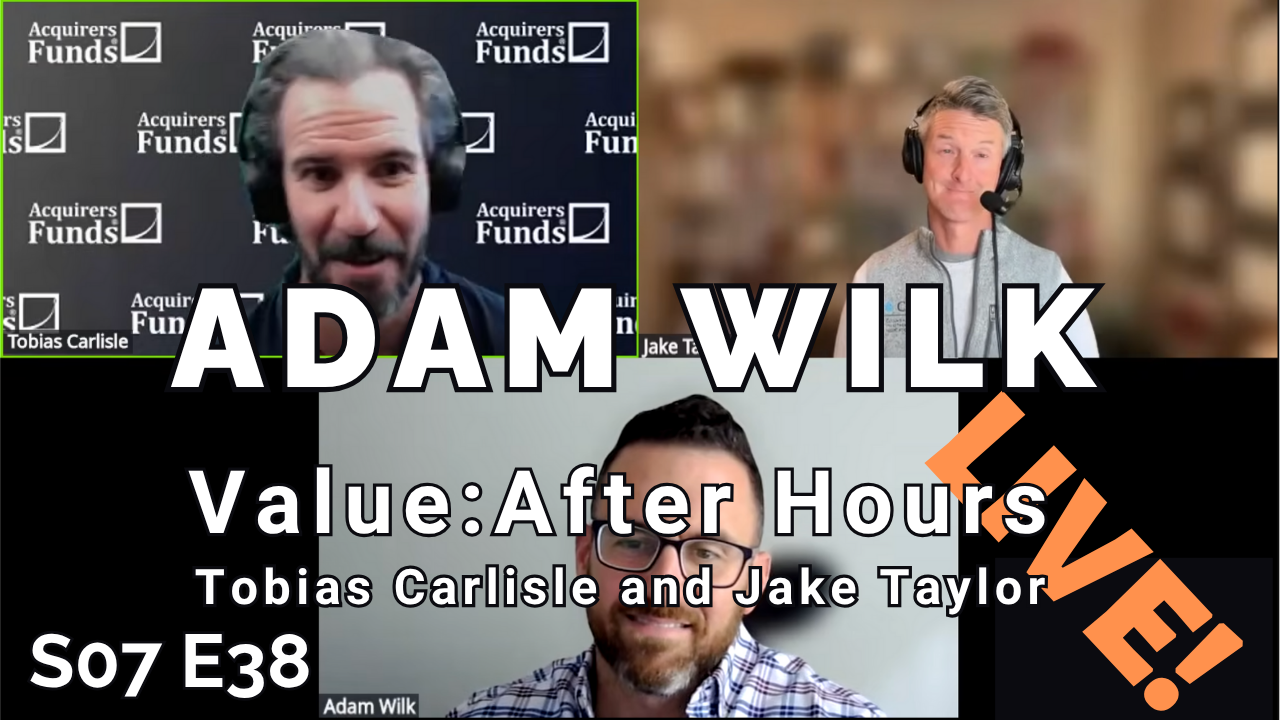
During their recent episode, Taylor, Carlisle, and Adam Wilk discussed APi Group (APG): A Hidden Leader in Fire and Life Safety Services. Here’s an excerpt from the episode:
Tobias: Just tell us a little bit about maybe the most interesting business that you have. Not necessarily the most undervalued, just the most interesting. I think commodity businesses are– they’re less interesting and then there are other businesses that are– like there’s some unusual niche that they’re exploiting. Do you have anything like that?
Adam: Yeah, I think APi Group. The ticker is APG. I think it fits that bill. It was one of the more fun companies that I got to know early on, which I knew nothing about. If you think about going inside of any commercial building in any city, there are a significant amount of fire safety systems inside of that building. My entire life, I didn’t pay any attention to those. Even during fire drills in school or any exposure I had to that, this industry or that this was a business or something was just non-existent. And so, I think that’s a very interesting niche and a very durable one too that APi operates in.
Just to give a high level– Cut me off if you need to. But they’re a fire safety and life safety business that provides fire safety inspections and equipment, and equipment maintenance of fire safety systems, like your sprinklers, extinguishers, valves, water pumps. They went public in 2020, I believe, so about five years ago, via SPAC. They have around 15% market share today. They’re the leading player in a really fragmented industry. What I came to realize, was that this is an excellent business. It’s recession resistant. It’s mostly because the maintenance activity that they do and the inspection activity is statutorily mandated by the National Fire Protection Association on all commercial buildings.
So, if you own a commercial building, you are required by the government to have your fire safety systems inspected and maintained at least once per year, but sometimes twice per year. So, that lends itself to recurring revenue. It’s acyclical. There’s a really high variable cost structure. If you think about the life of a fire safety system, it starts at building construction, where contractors will subcontract out the work to install all of the sprinklers, the alarms, the pumps, etc.
Most businesses in Api’s industry, they chase that installation work, because it’s higher dollar value and it’s easier to manage. So, you have one or two projects per year for a million bucks or whatever the case is. It’s a lot riskier, because the projects are longer in duration and they’re cyclical, because they’re tied mostly to new building construction. But APi’s approach is very different, because they lead with the inspection work first. So, they’ll sell a sprinkler inspection, for example, for $2,000 or $5,000 twice a year. And they believe that inspection related work leads to $3 to $4 of additional service work. You inspect a sprinkler and you find a corroded pipe, for example, and then you can fix that and do additional service work.
This part of the industry is higher margin, and it’s less risky, and it leads to faster turnaround time, so cash collection is better. But it’s more complex. So, there’s more smaller dollar projects to manage. Its lower cost, and it requires a lot of infrastructure that mom and pops, who they compete with don’t have.
There’s also the smaller portion of the business called specialty services, which there’s some construction related and HVAC related stuff there. But the history of the business is really interesting, which we can talk about on top of the fire safety services, but they also acquire– It’s like a 100-year-old business that was acquired from a founder who grew the business from his father and executed it really well. He didn’t want the company to be carved up by private equity, so he sold to a group that basically takes companies public, and keeps them together, and just grows them through organic growth and M&A.
They also acquire a lot of smaller, medium sized businesses in fire safety which they can purchase for really significant multiples. And so, I just enjoyed getting to know that business– Like I said, it wasn’t something that was ever on my radar. When I found it looked, I think it was around a billion-market cap or something and I thought they could do maybe like a billion in EBITDA which they’re going to do I believe this year.
I spent a lot of time with fire department. So, I went out and visited with like fire teams and talked to people in the industry, just got a sense of like, how you do these inspections and what matters and where the value prop lies and is if there’s pricing power there and that sort of thing. So, I think of all the businesses in the portfolio that was one of the most fun to due diligence and there was like a real tangible aspect of that process. And so, I think that fits the bill as maybe the most or one of the most interesting businesses in the portfolio.
Tobias: Can you just walk us through the valuation a little bit?
Adam: Yeah, sure. So, APi Group, the share price has increased I believe 5X in five years. So, we’ve done well on the investment. But I think there’s still a significant runway for growth. I can underwrite I think a 15% to 25% return per year from here over the next three to five years. I don’t have my numbers in front of me, but I believe there’s a 6% free cash flow yield today that’s growing 15% per year. And on the back of mid-single digit growth, organic growth, and some M&A, I think they can do around $1.3 billion, $1.5 billion in free cash flow within three years or so. The market cap today is $12 billion or $12.5 billion.
I think these businesses just given their growth profile, their recession resistance, their durability, the management team, capital allocation, the margin profile, I think these businesses deserve to trade between 15, 20 times or so. And at 20 times, it’s a $25 billion, $26 billion company. And so, I think there’s a path to get there with just simple blocking and tackling.
But then, there’s some upside on further M&A. If organic growth goes higher, they’ve been pruning some business in some of their segments right now, which has caused the top line to look a little bit slowed down. But they’re also under levered, I think. So, any increases there they can go up to I think three, three and a half times to do some more deals. So, they can probably acquire $50 million, $60 million in EBITDA per year in addition to the organic. And so, yeah, there’s lots of levers to win here.
Management has a lot of skin in the game. The chairman is run multiple public companies before with great success. I think they’re incentivized to create a lot of value. So, it’s one of the companies that feels like a never sell business. I think revenues and earnings will be higher 5, 10 years from now. I’m excited about what the future holds.
Tobias: What do you think about that SPAC process going public via SPAC? What’s the reason for doing that? Because the founder was looking to step out– I understand that part, but why not just go public?
Adam: Yeah. So, it’s not my favorite way to do it. In this case, I think the group that brought the company public has been and will be well compensated for doing it that way. But I think the environment was one thing, a speed to going public, like a speed to market and a lack of roadshow means that there’s an interesting story to tell for growth and margin sometimes, like in the IPO process. With a company like this, you say you’re going public at a certain valuation and certain margin targets, there’s maybe only downside from there. And so, I think the lack of that formal process was helpful to APi in that case.
But yeah, I think it also helps– Despite the fact that the group that brought the company public, it has been paid well, I think it also helps align interests and incentivize them to create value. There’s a compensation structure in place that basically states that as the shares increase in value, management is paid a little bit more compensation. And so, it’s directly tied to creating value in that way without dilution. I think it was a hurdle to get over initially, but the track record of the people bringing the company public gave me a lot of comfort, and I thought that the playbook could be very similar to some of the prior companies that they operated.
I don’t have to speak as vaguely, I guess. The chairman of the business is Martin Franklin, who has a long history in public markets, and he was a CEO and chairman of a company called Jarden. And that business, I think, did 30% per year for two decades or something along those lines. I can’t remember the exact timeline, but some phenomenal return there. Then he’s done some other things as well, both that have worked and not worked.
So, I got comfortable with him, and his track record, and the founders of the business and the way that they were approaching it. But it’s not my favorite way to do things. I think for every successful SPAC, there’s a hundred unsuccessful ones, or with sleazy promoters, or really bad compensation structures, or evidence of things that have not worked out.
You can find out more about the VALUE: After Hours Podcast here – VALUE: After Hours Podcast. You can also listen to the podcast on your favorite podcast platforms here:

 Breaker

 Overcast


 RadioPublic


 Stitcher

 Undervalued Private Credit Investing: Finding Value in Discounted Lending Funds
 Where Is the Deep Value in Canadian Stocks This Week?
 Investing Beyond AI: Why Traditional Businesses Could Still Thrive