
VALUE: After Hours (S07 E32): CapEx, AI, and the Prisoner’s Dilemma
Wednesday, September 24, 2025 · Johnny Hopkins
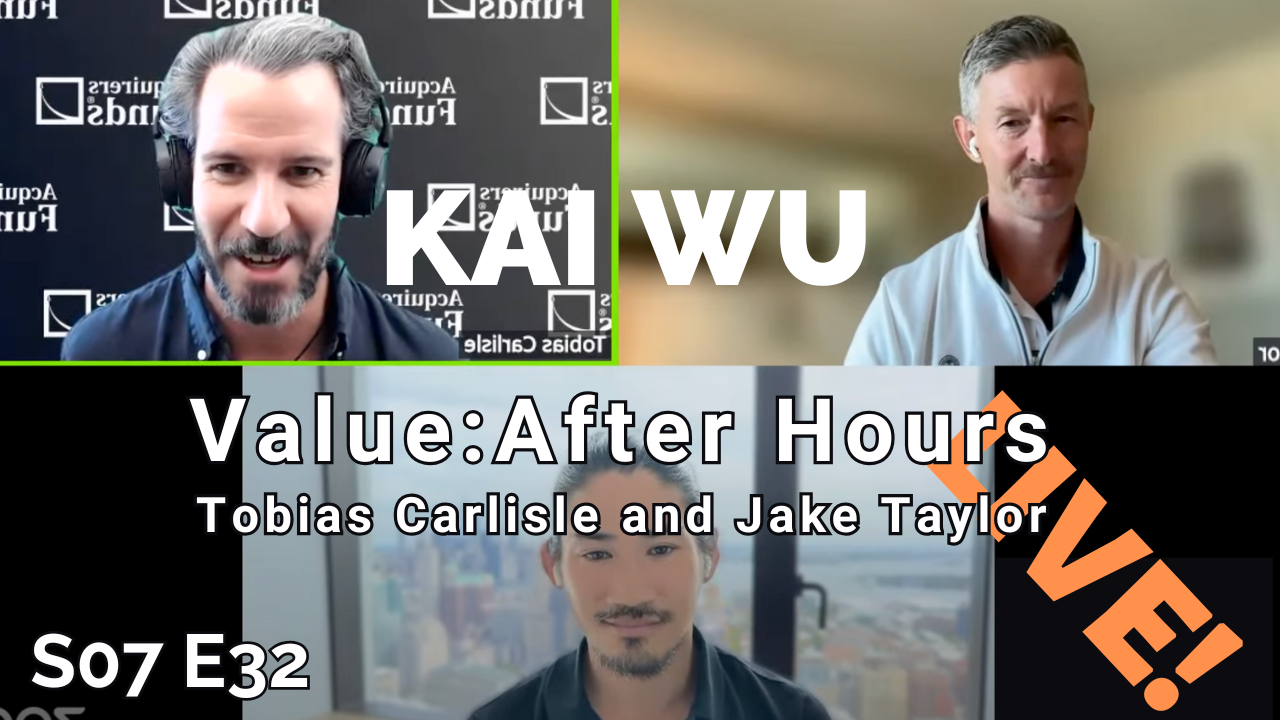
During their recent episode, Taylor, Carlisle, and Kai Wu discussed CapEx, AI, and the Prisoner’s Dilemma. Here’s an excerpt from the episode:
Tobias: Yeah, that was where my question was going. I saw a chart on Twitter last week, at the end of last week, that said that the Mag-7 or whatever, the AI CapEx spenders are classified under– They’re spending something like 60% of cash flows, which is double what it was 10 years ago on this build out. And then, the impact of that will be in about three years’ time that their return on invested capital is probably half where it is now as a result of those depreciation, amortization starting to hit the financial statements. What do you think about the likelihood of that?
Kai: Yeah. We don’t really know whether return on this investment will be. There is a state of the world where we achieve artificial general intelligence, and there’s only a few companies that have the service to do so, and they are a cartel and they don’t cut prices so they collectively earn all the rents. There’s a state of the world that that happens.
There’s also one in which artificial intelligence disappoints that it’s not adopted by the enterprise. There’re no real use cases. It’s too faulty. Even if it does succeed in the long run, there’s a state of the world where there’s a short-term hiccup in which case these stocks which are priced close to perfection will rewrite and these companies will have to readjust their investment plans.
And then, there’s the base case. I think, Toby, what you’re outlining is the base case that we’re transitioning from– Think of, I don’t know, Meta as being the average of this amazing asset-light business model and this okay utility model. That’s my base case, which is that they’re just averaging into a less good business. If they could spin out this data center thing, it would be less attractive. But there’s of course these really extreme tails that’s difficult of course to handicap that probability. So, it’s hard to say.
The way I think about things is just from a risk standpoint, which is like, there’s basically been one risk vector, so to speak, that is now driving markets up, markets down and that is Mag-7 and more particular AI. The AI theme within Mag-7. If people are bullish, the stocks go up. And if they’re bearish, stocks go down. It’s not a great market structure, it’s a fragile market where there’s one principal component driving everything.
And so, to the extent, you are an investor, you’re thinking, maybe I’ve done pretty well holding S&P 500, NASDAQ, QQQ, whatever, that’s been great. But at what point do I want to think about taking these chips off and maybe diversifying into other things? How do I do that in a way? That’s not just buying companies that are oppositional to this. They’re not negatively exposed to innovation, they’re just at least neutral or still positive, but maybe just less concentrated in a few names.
Tobias: I think it’s funny to look at the reaction to the market, to the spending now versus when Meta was doing it a few years ago under the Metaverse name, which people just hated and it sold off. I guess that some of that reinvestment was happening before the– It wasn’t CaPex, it was happening sometime further up the financial statement, so it was crushing their free cash flow as well.
So, I guess there were two elements to it, but I feel like there was this fear that everybody had sealed themselves into the rocket ship with Zuck for the run to the Metaverse, and then halfway through two years and he decided he didn’t want to do it anymore.
Kai: Yeah, I remember that when he called off the investment splurge call for the year of efficiency, stock did really well. That would be the dream state for these companies, I guess. That’s the other dream scenario where it’s one in which they all collectively say, “You know what? This was a fever dream, let’s just step away, no more investment.”
One of the concerns I think, is that a large component of the reason why these companies are investing so much is this game theoretical arms race component. Whereas if you’re Google, you need to protect search at all costs, that’s your entire business. And to the extent, there’s something that can potentially impinge on that, it’s not a choice. I think Zuck has even talked about this specifically, but how this FOMO trade and you have to– The downsides of not investing are too high. So, you have this from a personal dilemma standpoint, you’re better off all doing one thing, but they do the opposite because they don’t want one guy to be the one who raises the head like China or SoftBank, and then they miss out. So, they all have to invest, which it makes sense– It’s rational for them to do it, but it’s like not necessarily the collectively the best thing if you’re a shareholder in all those companies collectively.
Jake: No. They had their own little fiefdoms carved up where they were all making a lot of money, but now they’re all going to compete in the same space. Maybe not as much profit pool thereafter when everybody’s in this blood red ocean together.
Kai: That’s right. Yeah.
You can find out more about the VALUE: After Hours Podcast here – VALUE: After Hours Podcast. You can also listen to the podcast on your favorite podcast platforms here:

 Breaker

 Overcast


 RadioPublic


 Stitcher

 Undervalued Private Credit Investing: Finding Value in Discounted Lending Funds
 Where Is the Deep Value in Canadian Stocks This Week?
 Investing Beyond AI: Why Traditional Businesses Could Still Thrive