
VALUE: After Hours (S07 E31): Unemployed Value Degen Stephen Farrington on small cap stocks $PTLO and $CROX
Sunday, September 14, 2025 · Johnny Hopkins
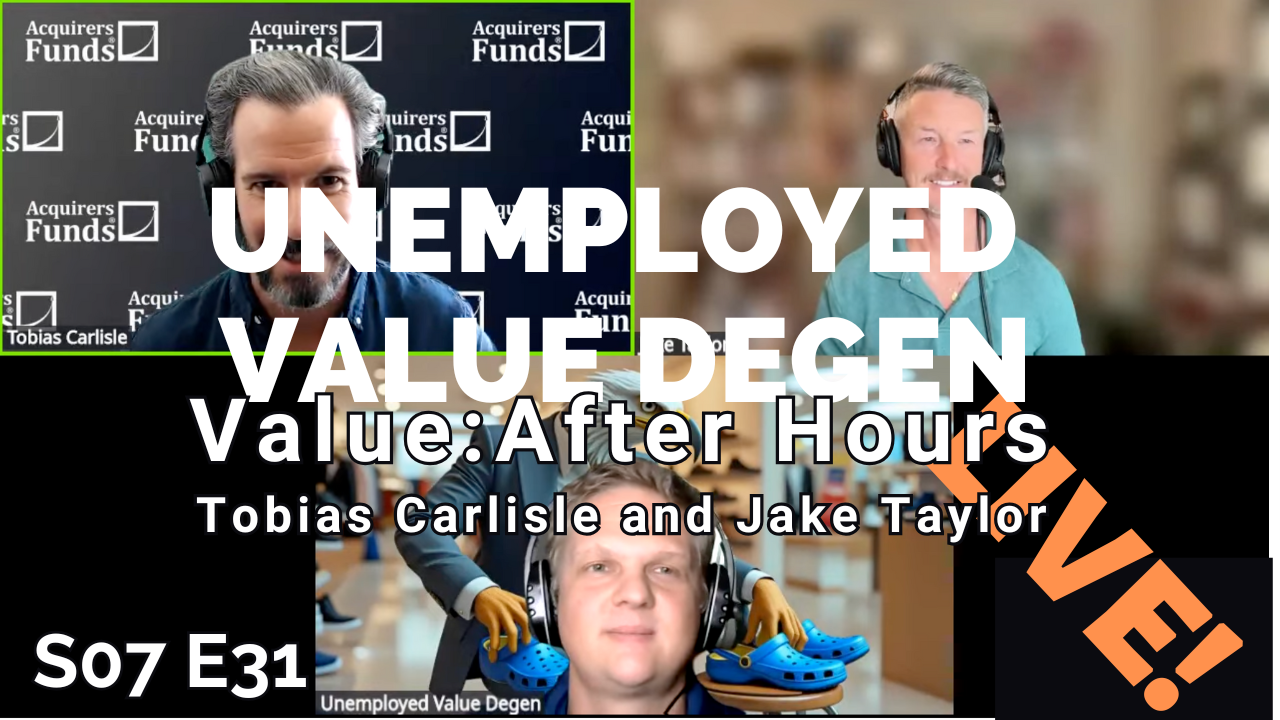
During their recent episode, Taylor, Carlisle, and Stephen Farrington discussed:
- The Hunt for Mispricing in Small-Caps
- Insider Buying: Finding Signal in the Noise
- Company Hack – Why CFOs and General Counsel Matter Most
- Portillo’s: Everyday Value Done Right
- Crocs: Ugly Shoes, Beautiful Numbers
- Expansion Beyond Chicago: Myth vs Reality
- The Pajamafication of Society
- Small-Cap Value vs. Mega-Cap Dominance
- Bacons of Truth
You can find out more about the VALUE: After Hours Podcast here – VALUE: After Hours Podcast. You can also listen to the podcast on your favorite podcast platforms here:

 Breaker

 Overcast


 RadioPublic


 Stitcher

TRANSCRIPT
Tobias: I think we’re live. This is Value: After Hours. I am Tobias Carlisle. Joined as always by my cohost, Jake Taylor. Our special guest today, Stephen Farrington. He is Unemployed Value Degen on Twitter and Substack. Welcome, Stephen. How are you?
Stephen: Oh, I’m fantastic. I’m a huge fan, so I’m going to try not to fanboy out too hard here. But yeah, it’s very grateful for the opportunity.
Tobias: You’re welcome. Your focus is small-cap value. Take us through a little bit about your philosophy and your history, how you got to this point.
Stephen: Yeah. Well, small-caps, I feel if you’re looking for value, the best thing is to go where the mispricing is the most extreme. And then, sometimes the mispricing lasts so long that even after the fundamentals have improved, the prices still haven’t adjusted. So, it can be a little frustrating.
I’ve learned over time that a lot of things that are cheap really turn out to be more cyclical. And so, knowing what I know now, maybe I’d be The Cyclical Degen. But there’s just a lot of things that have huge, enormous cyclicality. At the bottom, people are saying, “Oh, this is obsolete. It’s going away. We’re not going to be doing this anymore.” And then, a year later, the prices tripled or 5x or something like that.
The Hunt for Mispricing in Small-Caps
So, yeah, I love the mispricing in small-caps. But if I was smarter for my writing, I would go up market cap a little bit, because every time I write about a mid-cap, it gets about 10 times the attention. So, it’s not a smart business strategy to focus on small-caps.
Tobias: Yeah. You want a Tesla [Stephen laughs] blog or a Tesla Twitter account [Stephen laughs] where you have millions of followers?
Stephen: That would be fantastic.
Insider Buying: Finding Signal in the Noise
Tobias: So, tell us a little bit about your philosophy. How do you identify undervalued small-caps, and what are you looking for?
Stephen: Oh. So, it’s very hard to be a generalist, because every industry has their own metrics that matter. So, every time you try and crack into a new industry, you’re really grasping in the dark. I have gravitated more towards price to sales than price to earnings, because there’s just so many accounting tricks people can use to manipulate earnings. It’s much harder to manipulate sales and revenue.
But one of the first places I look– This ties into my background a little bit. I was a former professor. I’ve been through all the classes for the PhD program and I’ve had way too much math. I really love insider buying. But when you speak to people that do the multivariate regressions, they say, “That doesn’t add anything to the model.” One of the problems with the people that use huge data sets, is they always assume that more data is better. And sometimes the parsimonious model is the best one.
If you take all insider behavior, you’ve got a lot of noise in there. For one thing, just forget about the insider sales, because most of the time you’re dealing with management who considers that part of their salary and selling is what’s supposed to happen. And you have other times.
There was a Scandinavian company, I remember. The CEO sold half of his position and the market was terrified about it. He even came out with a press release. He said, “Sorry, guys, I’m going through a divorce. I still believe in the company.” [Jake laughs] So, just forget about the sales and look at the buys, because there’s only one reason why somebody that works at a company is going to buy stock in that company.
Even then, I ignore the directors, most of the time. Sometimes I’ll check out the biographies of the directors and see if they really have good experience that industry. But I would ignore the insider buying from independent directors, and even the chief executive officer. So, one of my PhD advisors– This was her area of research.
Chief executive officers, if you look at them, there is an advantage to managing a company with a chief executive officer who is consistently wrong, but he’s biased optimistically. So, if you have a CEO that says, “Next year, we’re going to have full self-driving. Next year, we’re going to have full self-driving.”
Tobias: [laughs]
Jake: Whoa, who are we talking about?
Stephen: “Next year we’re going to have full self-driving.” So, CEOs that are consistently wrong, but are wrong overshooting their estimates. Their engineers produce more patents per engineer.
Jake: Because they believe it’s possible.
Stephen: There’s this huge advantage to leadership. Yup, you got to make people believe. So, CEOs have to make people to believe. And in making people believe, they believe. So, I love to ignore CEO buying and director buying. I go straight to the most pessimistic bean counters. I want to see, when is the CFO buying?
Tobias: [laughs]
Stephen: And even better, when is the general counsel buying? Because you take the most pessimistic people in the building that have all the information to know where all the bodies are buried and know where all the risk is. And if I see a chief financial officer take $300,000 out of their checking account and buy stock in a company, and I see the general counsel take $200,000 out of their checking account and buy stock in the company, then I’m engaged.
So, maybe on average, insider behavior is noise. But within that noise is a lot of signal if you know that the parsimonious model is sometimes more correct. So, that’s insider behaviors. Maybe my most favorite screen, especially for being a generalist and not knowing so much about every industry.
Jake: I’d be curious if you could move that to even, like treasurer or the comptroller. Because it’s like, “Okay, the cash is real.” [chuckles]
Stephen: Yup, exactly. Chief operating officers are pretty good too. But you just have to know the CEO. He can be wrong. He can believe he can drink the Kool Aid. And directors, they could be doing a better job. But there is real hard kernels of data in the insider behavior, and it has worked out well for me in the past.
Tobias: I think that’s a pretty clever hack, actually, because as a former general counsel, I can confirm that the CFO and the general counsel are the most pessimistic guys in the building.
Why CFOs and General Counsel Matter Most
Stephen: If they’re buying, I’ll just take a flyer and punt on it and buy some as well, if I see a company with those two at the same time buying. I think that recently happened to one of the companies I was going to talk about today. I’d have to double check. No, I was going to talk about two stocks today, Crocs and Portillo’s. And in Portillo, you had big inside buys by the CFO and the general counsel at the same time, and large for the size of the company.
Portillo’s: Everyday Value Done Right
Tobias: Well, let’s talk about Portillo’s first. We’ll come back to Crocs, since we’ve started along that line.
Jake: Toby, have you ever eaten at a Portillo’s?
Tobias: I have not. No. Is that an East Coast thing? On the West Coast?
Jake: Chicago, originally. Yeah.
Stephen: It’s a Chicago native restaurant. Yeah, so, a Chicago native. They even have a special called The Leo for the new pope, who’s from Chicago and enjoys Portillo’s. So, Portillo’s is a fast-food chain. Their market niche is interesting. So, they’re going for everyday value. So, while McDonald’s was trying to sell $9 cheeseburgers, Portillo’s, they’re trying to capture the everyday value market to make sure that their food is high-quality and affordable.
It’s where to start, where to untangle this thing, because it’s such an amazing business. I remember before I had ever looked at a restaurant, I had just seen the statistic that Chick-fil-A crushes all the competition, because they do $7.5 million of revenue per location. Well, Chipotle does $5 million revenue per location. McDonald’s does $3.5 million of volume per location. A restaurant like Crystals do a million dollars. Something like not a Dunkin’ Donuts, but like a Baskin-Robbins or a Crystals is doing a million dollars of revenue a year per location.
Jake: Yeah. Or, Subway is like way down.
Stephen: Yup, Subway’s way down there too. Subway, they now have the problem that got bought up by private equity, who now wants to sell a $13 sandwich and the quality hasn’t improved.
Jake: $13 foot long?
Stephen: $13 for a Subway sandwich.
Jake: Doesn’t sound as good, does it?
Stephen: Well, I was at a conference with my wife and it was on the beach. I thought, oh, well, maybe this is just beach pricing. I talked to the staff. They were like, “No, no. All Subways are like this now.” So, $13 a sandwich everywhere. I’m like, “What are you doing? [crosstalk]
Jake: Thanks, Jerome. [laughs]
Tobias: You can’t charge more than a dollar an inch. That should be put in the Constitution.
Stephen: [laughs]
Jake: I’m going to leave that one alone.
Stephen: [laughs] Oh. So, Portillo’s is going for the everyday value market. When the founder of the company sold it, so he sold it to a private equity firm, he didn’t sell it to the highest bidder. He sold it to someone who promised, “We’re going to maintain this culture, we’re going to maintain this value. It’s going to be an everyday value business. We’re not going to jack up the prices.” And the founder of the company sold it. They only had 50 restaurants at the time. Sold it for a billion dollars to private equity, who took it public and has been trying to grow it aggressively.
Now, where to start? So, I told you, Chick-Fil-A does about $7.5 million per location. A Portillo’s in the Chicago area does about $10 million a year in revenue per location. And Chick-Fil-A has an average ticket size of about $15 a person, Portillo’s has an average ticket size of $11 a person. So, think of Chick-Fil-A on a Saturday and how busy it is, and then think that Portillo’s is going to have about 40% more people than that. It’s just enormous, massive amounts of volume.
In restaurants, the bigger the menu, the more likely you have waste or spoilage. They have an enormous menu, but they’re able to keep it moving with that much volume. Portillo’s location will do $600,000 a year in salads. I think Sweet Beans has only done about $2 million in salads. It’s just doesn’t have something for everyone. Their signature item is the hot Italian beef sandwich. But they have milkshakes. Of course, they’ve got Chicago hot dogs. They’ve got hamburgers, they’ve got a nice selection of salads and they serve beer.
So, it’s fast food. There’s no tipping. It’s adamantly no tipping. It doesn’t ask you for a tip. It’ll never ask you for a tip, because they want to be everyday value. But the inside is decorated like an Applebee’s or a Chili’s. So, it’s like a sit-down restaurant, but you bus yourself and there’s no tipping and then they serve beer.
So, for me, it has this fantastic market niche I think is very attractive. At the same time, the customers get absolutely hooked on it. So, there’s a concept in marketing for brands called Net Promoter Score, which is how likely you are to recommend this business to a friend. And Portillo’s crushes all competition on Net Promoter Score.
I lived this firsthand, because I hadn’t heard about the company. It was a former professor and one of my students, his girlfriend was doing a master’s degree in Chicago. This student of mine, he texts me out of the blue. I swapped phone numbers with about four or five excellent students. If I was smarter, I would have done that with 100 students. But I was only smart enough to swap phone numbers of about four or five excellent students that were really going somewhere and making things happen. He texts me out of the blue and says, “You have to try Portillo’s.”
This is a student. So, he graduated in two years. He was the most ambitious student I’ve ever met in my entire life. We had never had a conversation about anything other than business. There’s no non-business. I asked them like, “Has your account been hacked? What is going on? Texting me out of the blue talking about the Portillo’s.”
Jake: Hot dogs, what are we talking?
Stephen: The Net Promoter Score of this company crushes everyone. If you have this simple one question survey, are you going to recommend this company to a friend? The answer is yes. And in a world where Google just takes all the profits in ad revenue, in a world where marketing, it’s just so hard to reach people, having that word of mouth that is real and effective, I think does matter.
It does take some time for these restaurants to become more established. But one of the big criticisms against Portillo’s and I think the bearish take on it is this can’t work outside of Chicago. And to me, that’s shocking. Because Chicago has always been one of the choicest test markets of the country, because their demographics are so diverse. If it can work in Chicago, it can work everywhere, because they have black, they have Hispanic, they have white, they have everything thing. It’s always been Chicago is the test market. And now, there’s this weird narrative on Portillo’s that it could work if–
They don’t know if it can work outside of Chicago. But they did expand to Arizona. They’ve got four restaurants in Arizona about 10 years ago, and those are doing the same volumes as Chicago. But recently, they’ve expanded to Texas, they’ve had a bit of a hiccup. So, their chief marketing officer got poached. Their chief marketing officer got poached to be the CEO of Giordano’s Pizza.
So, on this big rollout, they’re doing this huge rollout without a chief marketing officer. And so, they’ve had some near-term stumbles and the market’s not believing it. I think that’s all short-term noise. This is one of the most amazing companies I want to own a piece of. They opened their first location in Texas, in Dallas. It was in the same shopping plaza as Warren Buffett’s Nebraska Furniture Mart. That first location in Dallas in its first year, keep in mind, your average Chick-Fil-A, that’s so packed on Saturdays and has the line outside that’s shutting down traffic, because it’s leaking onto the highway, that is $7.5 million of revenue a year. The first location in Dallas did $17 million in revenue its first year.
Jake: Wow.
Stephen: The management on the earnings call said it almost broke the store. This is ridiculous. So, they did a hub and spoke. They opened five more locations to try to siphon the traffic away from this location next to the Nebraska Furniture Mart. It did siphon the traffic away, which it was supposed to. But now, in their data, you look at the 2023 cohort and people say, “Well, why did traffic fall in the 2023 cohort?” Well, because it was intentional, because they had to siphon some traffic off of. You can’t have one fast food location do $17 million of revenue a year. It just breaks the whole system. It’s just nuts.
But there’s so much I like about the company. They’ve got a great management team. They’re iterating quickly. They’re experimenting to try and figure out what works. So, they’re just launching breakfast options now in Chicago. So, you’re already doing $10 million of revenue a year. They could start including breakfast on top of that. I mean, that’s just absolutely amazing.
So, they’re going to see, does it work? Does the market like it? I think when you have a new chief marketing officer in there to handle the store launches a little bit more appropriately– Oh, and in March of this year, they just launched a membership rewards program to get people to sign up and download the app. They got in the first six months of this membership program, 1.9 million reward members. They only have 86 locations. They have 86 locations and they have 1.9 million rewards members. That’s over 20,000 rewards members per location. Chipotle only has 5,000 rewards members per location.
The customer base of this company is so fanatic that on my write up on Substack, every paragraph I interspersed, how can you tell if somebody eats at Portillo’s? I was like “Don’t worry, they’ll tell you.” So, I did– [crosstalk]
Jake: [chuckles] It’s like going to Harvard and Portillo’s.
Expansion Beyond Chicago: Myth vs Reality
Stephen: Yeah. And then, I have to ask myself, so why is the market sleeping on this? I always want to know if the price is wrong, why is it wrong? And part of it is just this false narrative that they can’t be successful outside of Chicago, which I think Arizona and Dallas has proven they can be successful outside of Chicago. But for some reason, this narrative has taken hold.
But the other one is, I think it’s like the story of Peloton. The people that work in finance have to use the product. And they haven’t opened a location in Manhattan. I think if they opened a location in Manhattan, the price to earnings ratio would go from 10 to 40, because suddenly people that work in finance would try the food. But they’re focusing on Sunbelt growth.
Yeah, I think most of the successful restaurant fast food chains that are fetching five times price to sales, seven times price to sales, they open a location in Manhattan, so people that work on the stock market can try the food. I think that makes all the difference. It works for Peloton. It works for a lot of these especially high-end luxury consumer brands.
Tobias: Can you walk us through the valuation a little bit, [unintelligible 00:17:19]
Stephen: Yeah.
Tobias: Steve. Sorry– [crosstalk]
Stephen: Yeah. There’s another reason the stock might have sold off. So, the private equity firm that bought it originally for a billion dollars, they have been slowly exiting. So, they’ve been taking their limited partnership LLC units and selling them in the market. When it does that, it looks like dilution. It looks like the share count is increasing, because the LLC shares that were off the market weren’t considered in the float. And that sales process is almost over now. I think they only have 1% or 2% left. When they went public, they kept around 50% and then over time, they sold into the market. [crosstalk]
Tobias: How did that show up, as like minority interest or something like that? How was that captured?
Stephen: Yeah. There’s another company that was like this, Finance of America companies, and my memory is– It’s in the 10k but it’s not in your scanner.
Tobias: Oh, it’s just in the notes, not online.
Stephen: Yeah. It’s not in the Yahoo Finance Numbers. It’s not in the Finviz numbers. Whatever data sets they’re pulling for this information, it’s fooling the retail investor or any algorithmic investor that they’re diluting. But they’re not diluting. They’re growing mostly through cash flow and a little bit through debt, because they wanted to. They only had 87 locations, they’re opening 12 this year. So, they’re trying to grow aggressively.
So, price to sales is $0.68 right now. I think Chipotle’s price to sales is $5 or $7. It’s just outrageous. Price to book is not super accurate, because they have some very old locations. Some of those old locations they own the land. So, you’ve got a lot of depreciation price to book with older assets that can throw off.
Price to earnings can get thrown off by this huge CapEx. You’ve got 87 locations and you’re opening 12 more, there’s this enormous CapEx affecting earnings. So, price to earnings right now is at $14.5. But again, you’re doing this enormous build out of locations.
For this one, I’d focus on price to sales. If the market starts believing then I think that’s going to go from $0.68 to $3 pretty quick. And then, yes, they really just need a new chief marketing officer. That’s on his game to come in and take this rewards membership program and have some fun with it and to pay a little more attention to their new opening launches.
And also, you’re just in a tight time right now for restaurants. So, a lot of restaurants are missing earnings and missing comps. So, you have restaurants generally are having outflows, and some of those are undeserved. So, two of the darlings in the restaurant space, Kavas and Sweetgreen’s, they focus their expansion on the Washington, D.C. area.
So, you look at year over year comps for Kavas and Sweetgreen’s, and it’s just through the floor. But Trump laid off all the government contractors in Washington D.C., where they launched their initial expansion in the first place. So, restaurants are struggling right now. The consumer is a little under pressure. This is just across the board every earnings call you listen to the consumer is more choiceful, the consumer is under pressure. I think that’s all going to go away once we–
So, this is a little off topic, but mortgages, the way as opposed to interest only debt, mortgages are taking money out of the system every month. Every time somebody makes a mortgage payment, the money supply is shrinking, debt is decreasing and that person individually is saving. Once mortgage rates are 5.5% for a 30-year mortgage and you have home equity loans pick up, a lot of people– Home Depot and Lowe’s are big on this in earnings calls. Everybody’s putting off the major projects, because they want a nice attractive home equity loan rate to put in a swimming pool.
Once the money is flowing through the system that– Just enough home equity loans to offset the natural behavior of mortgages pulling money out of the system, then that money is going to work its way through the economy. People are going to be a lot less choiceful. Everybody’s going to have more money in their pocket. So, there’s a lot of negativity out there. What’s 50 basis points of interest rate cuts going to do? I think it could have a huge effect on home equity loans, and building swimming pools, and putting in a new deck and redoing your kitchen. All that money is going to circulate through the economy. And this consumer choicefulness I think is going to go right out the window once that money starts moving again.
So, I think it’s a great time where restaurants are hated, and the sector has outflows and you’re buying this thing for– The market cap right now is $495 million. So, when the founder sold it to private equity for a billion dollars, it only had 40 locations. So, you’re buying it now for half the price with twice as many locations. So, it’s about a fourth of the price as when private equity first bought the thing originally. I’m pretty locked in. Portillo’s is one of my bigger positions.
Tobias: Somebody asked Buffett about this at the last meeting?
Stephen: I don’t know.
Tobias: There was a Portillo’s that showed up in the– Do you know what I’m talking about, Jake?
Jake: Mm-hmm.
Stephen: Yeah. I didn’t see–
Jake: Yeah. But it was something else like they were off on it.
Stephen: Yeah. I missed the last meeting. I know this is the temple of Warren Buffett. My one take was I was going to talk more about on Crocs, if we’re pivoting to Crocs. Crocs had 30% year over year growth in China. American companies are just notorious at not being able to penetrate China. I think the recipe for why they’re so successful is because Warren Buffett was asked about this during The Kraft Heinz acquisition. He was asked about why not all these other consumer staple companies. And the topic moved to, “Aren’t they just charging too much?”
For example, Nabisco Crackers. The white label box of saltine crackers is $1.50 and Nabisco is charging 4 bucks for a box of crackers. Aren’t these markups just too much? Warren Buffett was coming down pretty hard on the side of, “Yeah, their brand is powerful, but they’re pushing too hard.” Crocs is the name brand for these resin injected clogs and they only charge $45. I think if they were pushing for $150 or $125 for the name brand clogs, they wouldn’t have 30% year over year growth in China.
Crocs: Ugly Shoes, Beautiful Numbers
When somebody is asking themselves, “Should I go with a knockoff or should I go with the name brand?” Well, if your name brand isn’t pursuing those aggressive margins, if your name brand is going for a reasonable price, there’s no reason to go for the knockoff. Chinese people love to go for the Chinese competitor. There’s this huge stickiness culturally in China. It’s like an old Buy American campaign, but it’s not even necessarily pushed so hard by the government.
There’s an old sociology political science paper that tracked after how many generations does an immigrant become indistinguishable from the native population? And for most immigrant groups, it was one generation. For most immigrant groups, if your kids grow up here and go to college, then they’re indistinguishable. The way they vote, the way they behave, you can’t tell the difference. For Chinese immigrants, it’s more than three generations. So, unless your great grandparents were building railroads in California, the cultural stickiness of the Chinese is just so powerful and so strong. So, every American company that goes to China has such enormous difficulty penetrating that market.
There’s Crocs with 30% year over year growth. Last quarter, they just flipped to 52% international, 48% US. There’s an enormous international growth story. They’re crushing it in Korea and they’re crushing it in Japan. It’s a combination of, they’re really good at social media marketing. They get the right influencers to wear their shoes and they don’t push the price. It’s 45 bucks for a pair of clogs. Why would you want the knockoff if the name brand is reasonable?
Jake: What is it about the Chinese culture that has a more stickiness?
Stephen: Oh, it’s central to it. French is a little bit similar, but the Chinese take it to a whole other level. The whole concept of the symbol for China, is that the line with a little circle in the middle, it stands for the Middle Kingdom. That’s the way of saying the center of the Earth. It’s just inherent within, this is the center of the universe, the sun revolves around China. It is, we are the best. If we are the best, why would you want to change anything about yourself if you’re already the best? So, it’s really foundational to the whole Chinese identity to be part of the Middle Kingdom, to be the best people on Earth.
My first 10 years of my career, I was a chef, and a car accident sent me back to college. It was a fantastic car accident, because I had a lot more to offer the world than a bearnaise sauce. I found myself working for a French chef in Honolulu. He would, [chuckles] at least twice a day, he would go through the kitchen and tell everybody, get everybody’s attention and say, “This is the best mustard. Do you know why this is the best mustard? Because it is French,” and then he would just leave the room. He would do that at least twice a day with a different ingredient. It was just that the ethnocentrism of it all. I always found it hilarious. But I think the Chinese–
Jake: Wasn’t French’s mustard American brand?
Stephen: No, no. He was talking about it was a whole grain stone ground Dijon. Yeah, anyway, but he would do that with a different ingredient at least three or four times a week. But Chinese take it to a whole different level. Just the Middle Kingdom, center of the Earth, it’s just so foundational to their identity and who they are that American brands, yeah, it’s very hard to penetrate there. But if you don’t push the price too hard and do the right social media marketing, there’s Crocs with 30% year over year growth in China.
Tobias: Can you work walk us through the Crocs opportunity?
Stephen: Yeah. So, let me take a step back and share a picture, because something amazing happened in the market last quarter. So, this graph is the spread between the realized move and the implied move. The normal outcome which has happened since the beginning of options trading is what happened to Nvidia last quarter. Last quarter, Nvidia’s implied volatility. So, if you are buying the options, you’re buying expensive options based on implied volatility, but the market expected Nvidia to move 9% on earnings. And then, when the earnings call came out, Nvidia only moved 4%. So, the realized was much less than the implied. That’s the normal state of affairs since options were invented for all of the history of options is how it’s been.
And last quarter for the first time ever that flipped. The average option, the realized volatility ended up being so much more than the implied. So, for example Crocs coming into last earnings. The implied volatility was 8% or 9% and the stock sold off from $101 to $75. So, the realized volatility was over 25%. And so, for the first time in the history of options, the people who buy options are on average making more money than the people who sell options. And that’s never happened before.
Maybe this is just a one off, maybe this will go back to mean reversion or maybe this is a new structural part of our market that these dips become so extreme when these sell offs become just absolutely crazy. That’s one aspect. And then, when I pull up the Crocs price chart– You can see that here. So, this last earnings call– Again, it was $101 and then just crashes down to $75. This was their highest revenue quarter ever. They absolutely crushed it. But there was enough in there for the algorithms not to like. So, there was a non-cash write down. There was a goodwill write down from their Hey Dude acquisition.
Three years ago, Crocs did a bad acquisition, and they overpaid and they spent $2.5 billion for a shoe brand called Hey Dude which is a Jimmy Buffett oriented– It’s a traditional shoe. It’s got several different kinds of fabric. Whereas Crocs, these resin injected molded shoes, they’ve got 60% gross margin on those things. When you switch to having four different kinds of materials that have to be stitched together, the margins go way down. And also, they are experts at social media marketing, but their social media marketing, I think they thought too highly of their expertise, because half of it I think is that Crocs fit the modern world much better than Hey Dude.
The Pajamafication of Society
I think I wrote about it in my Substack write up that there is a pajamafication of society that everybody’s walking around in their yoga pants and their clogs now. So, yes, Crocs are masters of social media marketing, but I think they accidentally had the right product for the time. And with the Hey Dude acquisition, they’re trying their social media marketing and it’s not getting the right traction.
But that bad acquisition was three years ago. And right now, the whole company together is being aggressively punished. And part of it those non-cash write downs. So, when you write down goodwill and generally accepted accounting principles, it shows up as negative income. And if you actually think that’s real income, even though no cash changed hands, you’d say that right now Crocs has a price to earnings of 8, even this is showing 20. But if you actually look at the operating cash flow, it’s trading at a price to earnings of four and a half. I mean this is just an incredibly cheap company that’s growing aggressively.
They also guided for a week next six months in the US, but everybody guided for a week next six months in the US, because the consumer is squeezed and there’s tariff uncertainty and there’s interest rate uncertainty. So, every consumer brand across the whole country is guiding for a week six months in the US, but then better after that. So, yeah, I think the selloff was overdone, and then on top of that these new world where the realized volatility is so extreme. I think the only strategy to overcome that is to know what you own, have a lot of small positions.
When a 40% dip or a 25% dip comes on earnings, and you know it’s a good company and you know what you own, then you can move quickly and grab on with both hands. That’s why my theme for the write up was the one that got away. Because I first found Crocs a couple years ago because of the insider behavior and I didn’t understand these stupid ugly clogs. I just didn’t get it. I was at my pediatric dentist taking the kids to the dentist for a cleaning, and there was an elementary school kid next to me for their family for the dental cleaning and they were wearing Crocs and they were all covered with the charms. They call them Jibbitz. I was like, “What’s the deal with Crocs?”
I said everybody in elementary school is wearing them, absolutely everybody. So, 25% of Crocs revenue is elementary school kids. What’s amazing about that is their feet grow. They need to have new replacements every couple years.
Tobias: That’s–
Stephen: [chuckles]
Jake: Yeah.
Stephen: [crosstalk] Constant demand. And then, another thing that’s amazing about it is you know the kids get bullied in school if they’re not wearing the name brand, but the name brand is 45 bucks, so what does it matter? But then, the customers who are fanatic about Crocs– It’s almost a little bit like beer, where in beer, I think 50% of sales is your 10% of your customers and 80% of your sales is 20% of your customers.
There are Crocs fanatics. And the Crocs fanatics, they’ll do a dyed to match approach. So, they’ll have a pair of Crocs to color coordinate every aspect of their wardrobe. So, the super users in Crocs– I think one of the reasons why Crocs is so underappreciated is because people that work in finance have to wear real shoes at work. But then, when they go home, their wife and their kids are all wearing Crocs. I think there’s a certain amount– There’s just a hatred there.
Let me go ahead and share this quickly. So, there was a famous value investor, Norbert Lou of Punch Card Management. Last 13F, he has 17.3% of his portfolio in Crocs. He bought it at over 100 bucks a share. So, you can buy it now cheaper than he bought it. And the hatred, the animosity on Twitter, “You waited your whole life for Crocs and PayPal???” As you scroll down, for every one thing that says, “Crocs is a legit company.” It’s just OMG, laughing faces, death skulls. This is the reaction when somebody sees you buy so much. The company’s trading at a price to earnings ratio of four and there’s nothing, but ridicule for people who want to buy Crocs. It’s just amazing at how hated it.
But I’ll go to my write up. So, there’s a Reddit page as R/Crocs where these super Crocs users will share their wardrobes. Let me share one of these. Hold on, let me click the share button, make it work again. That’s 29 pairs of Crocs at 45 bucks a pair, plus decorative Jibbitz and things like that. And on this R/Crocs Reddit, these super users will go on there and say like, “Yeah. when I’m at the mall and I don’t want to leave empty handed, I want to buy something, I’ll just buy a pair of Crocs,” or they’ll buy some of the charms to decorate the Crocs with. So, you got 25% of their sales is the children for elementary school, but a huge amount is to adults. This is a massive housewife phenomenon, because they want to be comfy, they want to have some comfy footsies and they will dye to match the color cord. They get one of every color of the rainbow and then some to match any possible outfit that they can imagine. And now, suddenly, you have somebody who’s spending $1,500 on resin injected clogs with a 60% gross margin.
Another thing that’s fantastic about it is because a lot of companies that I’ve dived into, they want to make DTC, direct-to-consumer, marketing work. Direct-to-consumer marketing is hard to make it work unless you have a razor and razor blades business model. Otherwise, if you advertise, Google takes 40% or the retail store takes 40%. A lot of companies have tried to do DTC, direct-to-consumer.
Half of Croc sales are DTC. Half of Croc sales, they just get to keep all the money. Because once you know your size and say you need olive green pair to match your wardrobe, half of their sales are just shipped through the mail, and so they don’t have to pay Google for advertising, they don’t have to pay the retail store for a markup. So, you have 60% gross margins. These aggressive super users that want one of every color. These elementary school kids their feet are growing all the time.
One other amazing thing they did is they now have these charms that you plug into the holes in the Crocs they call Jibbitz. Wd what’s amazing about that for elementary school is I think somewhere around 20% of public schools have school uniforms, and kids hate that. Another 40% of public schools have a dress code that’s categorized as restrictive. It’s not a uniform, but the dress code is extremely precise. These elementary school kids, they’re grasping for some way to express their individuality. It comes out by going to the mall and paying 20 bucks for a five pack of Scooby Doo Jibbitz to put on your Crocs.
So, they found a way to get 20 bucks out of people at a time when they go to the mall to decorate their shoes or they will order them online direct-to-consumer and not have to pay those markups. So, this is an amazing company. And if you look through the non-cash write down, it’s trading at a price to earnings ratio of a four and a half to five– So, I’m with Norbert Lou of Punch Card, that you can have a pretty interesting chunk of your portfolio in Crocs.
Tobias: Yeah. Full disclosure, I hold some Crocs in accounts. Imagine four and a half times earnings, not a lot’s got to happen for that to go right.
Stephen: Yeah. Oh, it’s so good. The first time I found it was because of insider buying and I just didn’t understand it. I just thought, these are stupid ugly shoes. They are stupid ugly shoes, but they’re stupid ugly shoes with a very dedicated group of super users that’ll just buy one of every color all the time. Growing 30% year over year in China, who can do that? Who accomplishes that? It’s amazing.
Tobias: Let me go around the horn very quickly and then JT, you want to do your-
Jake: Yes, sir.
Tobias: Vegetables? Petah Tikva, Israel. What’s up? Tallahassee. Lewes, Delaware. Pronunciation is always appreciated. Toronto. Palestine. Haifa, Israel. Jupiter, Florida. Tampa, Florida. Gothenburg, Sweden. Sounds good. Valparaíso. Gävle. That’s a hard one to say. You might have to give me the pronunciation for that one. Vienna, Austria. Breckenridge. Surbiton. La Ràpita, Spain. Cardiff, Wales. Philly. Bellevue. Gavere, San Diego. And over to you, JT. Bergenfield, New Jersey, last one. Over to you, JT.
Jake: Austria? Well, good day, mate.
[laughter]Bacons of Truth: Lessons from Roger & Francis
Jake: All right. So, today, this segment is a play on words called Bacons of Truth. Not beacons, but Bacons, and you’ll see why in a bit. I want to take you on a journey across centuries, from the cloisters of medieval friars in the 13th century to courtly halls of early modern England. And our topic is this timeless question, why do human beings struggle so much to reach some kind of capital T Truth? It’s as relevant today with Twitter threads and investment fads as it was back in the day of Scholastic debates and royal decrees of the ancients.
We’re going to learn about two remarkable thinkers, both with the last name of Bacon, which is quite curious. Hence this segment is Bacons of Truth. These two men were Roger Bacon and Francis Bacon. And no, they weren’t related, and they lived about 400 years apart. But they both tried to answer the same riddle, “Why do we get truth so wrong so often?” So, we’ll start in the 1200s with Roger Bacon. He was a Franciscan friar. He lived in a world dominated by scholasticism, where theology was the queen of the sciences and Aristotle was this unchallenged authority.
Roger wasn’t anti-Aristotle exactly. He was just suspicious of blind obedience to any authority. And so, in writings in 1267, he identified what he called four obstacles to truth. We’ll walk through them real quick. So, first is unworthy authority. Bacon argued that people leaned too heavily on authority figures, whether that was Aristotle or Augustine or whoever was considered the great sage of that moment.
And the second was long-standing custom. Bacon noticed that tradition has a hypnotic power. And just because a practice or belief has been around for generations, people treat it as then, therefore true. For instance, medieval medicine clung to Galen’s humoral theory. Not because it worked, but because it was old, so they’re bleeding you out to save you. Think of how often the answer to why is simply because that’s how we’ve always done it.
So, number three was popular opinion. Bacon warned against mistaking the consensus for the truth. He said, “Just because everyone believes something doesn’t make it correct.” And fourth, the concealment of ignorance with a show of wisdom. This is a direct jab at scholars of his day who papered over their ignorance with jargon and rhetoric, maybe speaking in Latin where the laity couldn’t understand.
Tobias: Host a podcast.
Jake: Yeah, host a podcast. [chuckles] It’s hard to hide your ignorance there. So, for Roger, the way forward was clear. He knew experiment, mathematics, direct observation. He was really centuries ahead of his time, essentially calling for the empirical revolution that wouldn’t arrive until really the scientific method took root.
So, now, let’s fast forward to the early 1600s. Francis Bacon was the Lord Chancellor of England, a political insider, philosopher and he was wrestling with similar questions. So, in 1620, he introduced what he called the four idols of the mind. These were false images, phantoms or illusions that distort our thinking, that type of idol. The first is idols of the tribe. These are errors common to human nature itself. We see patterns where none exist. Remember our segment we had a while back on Pareidolia? We exaggerate. We remember the evidence that confirms our beliefs and ignores the rest.
Second, we’re idols of the cave. This is your personal biases shaped by your upbringing, education, temperament. Each of us has lived in our own private cave effectively. Some of us are cautious, some of us are reckless based on our experiences.
Third was idols of the marketplace. These come from language. Words are not neutral. They’re slippery, ambiguous, often misleading. We argue about words instead of realities. Debates about maybe freedom or justice often turn into shouting matches, because we haven’t really clarified what we mean.
And fourth, idols of theater. These are errors inherited from philosophical systems or ideologues. So, just like actors play these scripted roles, scholars play within the scripts of their intellectual traditions. I think you see that whatever reigning paradigm is used instead of investigating the world, they interpret it through some pre written script.
So, Francis Bacon’s remedy for all this was a systematic new method. Careful observation, inductive reasoning and the patient accumulation of facts, which we all now call the scientific method. He was the father of that. So, how do these frameworks line up? They’re both very suspicious of inherited wisdom. They both want the truth to be tested, not just accepted. They both anticipated in their own way, actually, modern behavioral science, that human error isn’t random. It’s systematic. If you merge Roger’s obstacles with Francis’ idols, you end up with something that looks striking like cognitive bias framework. Centuries before Kahneman and Tversky, the Bacons were sketching the same terrain, the way our minds systematically fail us.
So, I’m going to skip some of this, because it’s already running long. But besides the historical curiosity of two guys, both named Bacon, putting forth four frameworks, four item frameworks, that map onto psychological biases, why does any of this really matter? It’s because I think the pursuit of truth is isn’t just about collecting facts. It’s about disciplining the mind against its natural tendencies to err. The truth was slippery in the 1200s, it was slippery in the 1620s and it’s slippery in your Twitter feed today.
The Bacons remind us that human error is not an accident. It’s a feature of how we think. And the question is whether we let those idols and obstacles rule us or whether we choose the harder path, which is testing, questioning and humbling ourselves before reality.
Tobias: Good stuff, JT. Did you land that one with the investment thesis?
Jake: What do you mean?
Tobias: Just generally be careful about the way you think.
Jake: Oh, yeah. Always.
Tobias: Be careful of behavioral errors. Good stuff.
Jake: Yeah. I mapped a bunch of those idols and stuff onto current day behavioral bias errors, but we were already running long, so I just decided to trash that.
Tobias: No worries. It was good stuff. Do you, guys, know enough about The Kraft, what’s happening with Kraft Heinz to talk about it?
Stephen: [crosstalk] thought a little bit.
Tobias: What do you understand? What’s happening with– We’ve had a few questions. It seems like Berkshire has a grand strategy playing out in real time with Kraft Heinz?
Stephen: Well, we’re in something like a spin off wave, which I think is welcome, because people know about economies of scale. You want to be bigger, to have scale. What’s often overlooked is diseconomies of scope. The more different stuff you do, the worse you get at it. And there tends to be a pretty big conglomerate discount that companies that try to do too much, they get punished in their valuations, their multiples. So, Kraft Heinz wants to split itself into two pieces.
You saw General Electric split itself into three pieces and it was welcomed by the market. And those three pieces now have much higher multiples in the parent company and are much more profitable. Honeywell is in the process of splitting itself up into three pieces. XPO Logistics in the process of splitting it up into seven pieces. I think this is very welcome, because we’ve had this massive wave, I think, pushed by zero interest rates to acquire all your competitors.
And the number of publicly traded companies from 20 years ago went from 9,000 to I think 4,500. It’s hard to make a Wilshire 5000 now, because you can’t find 5,000 companies. So, I think the spinoff wave is welcome and timely. I think it is just even more evidence that the zero-interest rate policy that they gave Bernanke a Nobel Prize for was completely insane, had enormous unintended consequences. I think he deserves more jail time than a peace prize.
But The Kraft Heinz one, they’re splitting the company to two pieces. It’s not that they’re splitting Kraft and Heinz, it’s that they’re splitting the grocery store business with, I think the more commercial business, the more industrial scale business. And so, there’s some Kraft on each side of the spin off and there’s some Heinz on each. So, it’s a strange splitting. I don’t know if that splitting is a– I know spinoffs in theory are welcomed by the market. I don’t know if the specific mechanics of that spinoff are good or bad.
And then, I think Warren Buffett had written that– Because they didn’t bring the vote to shareholder they’ve did it. They just started enacting it. As a large shareholder, I think he felt pretty abused by not having a say in the matter. So, that’s all I can say about The Kraft Heinz spinoff.
Jake: I have to recuse myself of this one, because my wife works for one of the subsidiaries of Kraft Heinz. So, I know too much. [chuckles]
Tobias: That’s good. I don’t have anything to add to that really, but that was a good summary. Yeah, Buffett seemed to me to be upset about it, but hopefully– [crosstalk]
Jake: Disappointed was the word he used.
Tobias: Disappointed. Yeah.
Stephen: I don’t know the details of the specific spinoff, because I’m not a shareholder and I haven’t dug into it. So, I don’t know if it’s because he felt that company shouldn’t split, or that the way they’re doing it is wrong or just that they should have asked him first, but I know he was not happy about it.
Tobias: What happened to the private equity firm that engineered all of this stuff? Are they still around? I imagine they’re still around, but they still putting stuff together like this?
Jake: Well, I think 3Gs been digesting a fair number of-
Tobias: Kraft Heinz. Yeah.
Jake: -previous acquisitions between the Tim Hortons-Burger King. Yeah, The Kraft Heinz. I mean, they did a lot of stuff in a relatively short period of time.
Stephen: One of the big problems in private equity right now is getting their exits. So, private equity they usually have in their rules, you’re supposed to try and exit in five years. And if you really need to push it, you can exit in seven. With this massive discrepancy between large-cap valuations and small-cap valuations, one of their exit strategies would be to IPO. But who wants to IPO when your industry is trading at four times earnings?
There have been these tiny little hints that we might be some rotation going on to small-cap value. If that occurs, you’ll see this enormous wave of IPOs as these pent-up private equity firms are able to exit. Right now, they’re playing games and they’re–
Some private equity firms are selling their stake back to the company and the company’s paying for it with a convertible bond issued by the companion private credit fund. So, right now, they’re just playing checkers with themselves. But if there’s ever an opportunity when small-cap valuation–
Tobias has been all over this for years and on social media. Historically, small-cap companies trade at a premium to large-cap, because just mathematically, if you’re small you can grow more. What’s been happening is with particularly intellectual property, sometimes economies of scale and also network goods. So, these are these large-cap tech companies, a network good has just fundamentally different characteristics.
Also, the market cap weighted ETFs and just the indexed buying, the large-cap growth companies have become so much more valuable than small-cap value. But if there is any rotation of small-cap value, you’ll see this massive wave of pent-up private equity exits waiting to happen and we can all hope– [crosstalk]
Jake: It is interesting though, because a lot of the big pools of capital have redeemed the small and mid-cap managers who would have been the ones primarily who would have bought some of these IPOs. [chuckles] So, when everybody’s just an index, mega cap indexer, who’s going to be buying random PE company XYZ that they want to take public.
Tobias: It’s not unprecedented in the data. It’s something that I looked at, because I posted– There’s a Yardeni chart that shows the S&P 100, which is the largest 100 out of the 500. We all think about the 500 as being super massive companies, because we’re small-cap value guys for the most part. But even within the 500, there’s the same phenomenon continues to occur when you get closer to the 100 or the NIFTY50 in the 70s or the Magnificent Seven now. They’re just getting peakier and peakier. You can track the performance of–
So, the Yardeni chart I think goes back so far as to include the 2000 peak of the 100 over the 500 and the current peak of the 100 over the 500. So, I went back to the Ken French data and used the size series there. That’s broken into deciles. And so, the largest decile is 178 companies, which is bigger than the 100, but it serves the same purpose. And then, if you take the top three deciles, that’s 535 companies. So, it’s equivalent to the 500.
Jake: [crosstalk] the hallmark. Yeah.
Tobias: You can run that back to, I think, at least 1926. It might be earlier than that. But there are very distinct peaks. Every single one of these peaks is around a famous stock market peak. So, there’s 1929 is the first one in the data, and then there’s a 1966 peak and there may be another one in there somewhere, but there’s definitely a 2000 peak. And then, there’s a 2020 peak, which is now a foothill relative to the 2025 peak, which exceeds all of the others,-
Jake: Wow.
Tobias: -except for 2000. It exceeds 1929 as well.
Jake: 2000 was still bigger, the 100 versus 500?
Tobias: Yeah.
Jake: Wow.
Tobias: It was. But you also have to remember there’s this drift, because small typically outperforms large. So, there has been this drift since 1926 to the tune of 0.8% compound a year for being in the 500 over the 100. It’s just these–
Jake: Oh, yeah.
Tobias: When these peaks come up, it destroys that sequence a little bit. And this peak started in 2014. It started breaking the-
Jake: The small-cap-
Tobias: -downtrend.
Jake: -premium.
Tobias: Yeah. So, it’s 10 years in this peak, which is the longest one that we have. None of them have had this really slow build to this kind of peak. But if we look at 2000, it’s equivalent to it being– It’s like October 1998, and the peak was something like May 1999 in this data. I know that doesn’t map exactly to the stock market, but this is the size.
This is one thing I’ve noticed in the Shiller PE data too, that the peak in terms of the Shiller PE doesn’t match up to the peak in terms of the market. I think it starts rolling over before the market peaks. I worked out that if this is 2000, if today is an equivalent peak, we’re like six to eight months shy of the very highest peak. At the moment, it’s 50 on this little chart. It’s a 50 and it needs to get to 52 to be equivalent to the 2000. So, it’s close– [crosstalk]
Small-Cap Value vs. Mega-Cap Dominance
Jake: Party on for a little longer, is that what I’m hearing? [chuckles]
Tobias: Seven months, room to run. Go bananas. Who knows it could be– [crosstalk]
Jake: Yellow?
Stephen: Two quarters away from looking really smart for spending so much time in small-caps.
Tobias: That’s right. There’re no guarantees, of course. It could be years, so there’s no reason why it has to match up. But it’s just an interesting thing, I just looked at it.
Jake: If have you ever seen data on Japan on this one, like in 1989? Was that big cap too?
Tobias: [sighs] I haven’t, but I assume so. The current market over there is a big cap market. Because I was searching for like, what’s the inverse strategy of what I’ve been doing which is small-cap value. And so I’ve been thinking– [crosstalk]
Jake: It’s called winning, Toby. [laughs]
Tobias: Yeah. Well, I don’t know how to do that. But I’ve been thinking like, you want momentum, you want high profit growth, you want profitability, none of that works.
Jake: Quality, all these other things.
Tobias: None of that works, because what you need is market capitalization waiting. You just put more money into the biggest ones and you do better. And so, for quite a lot of the time in the market, you look smarter just buying bigger stuff. So, there’s a good argument for just making a hyper concentrated, the NIFTY50 style strategy. But then, ultimately, you’re wrong. You lose more money than, [chuckles] you’re going to be down. You don’t make money, but you go for long periods of time looking like you’re not doing run an arc or something like that.
Jake: Almost a whole career.
Tobias: Yeah. It could be. With any luck, we get to run the other way. What do you think—Steve, you got any views on that phenomenon?
Jake: When does the pain stop?
Tobias: Yeah, that’s all I want to know.
Stephen: It feels like it’s so overdue. [Jake chuckles] So, there’s so much money in these passive ETFs. If the money is in the Mag-7 ETF, then even if so, right now, it feels like– And I could be easily wrong. But it feels like Nvidia on its last earnings call, they hit all of their targets, but they didn’t surprise the upside. Once a growth trap stops surprising to the upside, then look out below. Also, there was the announcement between OpenAI and Broadcom to make AI chips. So, now, Nvidia is losing the monopoly veneer and they stopped surprising to the upside.
At a $4 trillion market cap, a 25% sell off is a trillion dollars. But I don’t know if that money is going to rotate into the other aspects of the Mag-7. Maybe Tesla starts looking shiny and new at the same time to absorb some of those inflows, or does that money get recycled into the S&P 500. So, I don’t know what it’s going to take for that money to find small-caps. And is absolutely right, is somebody has to be buying it.
Even the active managers, a lot of this– I think more than 60% of active money is algorithmic. So, the small-caps have to do something that looks good to the math equations. One aspect of that is going to be interest rate cuts. So, large-caps have a lot of fixed debt, small-caps have a lot of floating rate debt. And that floating rate debt, obviously, it won’t change EBITDA, but it’ll change net income.
So, you take a company like Sleep Number, mattress company. I have a write up on my Substack about one of their competitors, Purple. Somebody posted online, “What stock do you own that you’re the most ashamed of?” [Tobias laughs] I put my write up for Purple the mattress company, because it has a lot of fundamental things for it that’s really interesting. But Sleep Number, their floating rate debt right now, their profitability is so thin that just the one percentage point of interest rate cuts would double their profits. Doubling profits is something that algorithms would get excited about. So, you could see a lot of that just coming from interest rate cuts.
There’s also the smaller cap companies in this world of new tariffs, a lot of them from earnings calls they’ve said, “Well we can change supply chains. We do have room to increase manufacturing capacity here.” So, you’re going to see some of the larger competitors, they can’t really divorce themselves from doing manufacturing in Vietnam and China. Some of the small-caps, they can get around the tariffs by manufacturing here. So, there is a really good chance. There is also the artificial intelligence about who’s going to become the ultimate artificial intelligence beneficiary.
I have a write up on United Natural Foods, UNFI, who is the distributor of natural foods. So, they’re the wholesalers. Massive thin margin business. $30 billion of revenue, 1% profit margins. But if they can get some efficiencies from artificial intelligence, it’s much, much easier for them to go from a 1% profit margin to a 3% profit margin than it is for a lot of large companies to– Take a company like Apple. How can they triple their profits? Well, not as easily as United Natural Foods could implement some AI tools and triple their profits.
So, there is a world where artificial intelligence ultimately benefits small and mid-cap companies. And then, once it gets momentum, all the momentum strategies are going to keep on pushing what’s working. One of the problems is small-caps haven’t been working, so momentum keeps it not working. Once that elastic gets pushed so far down– If you start having a trillion dollars come off of Nvidia and earnings in small-caps are growing because of implementing AI tools and because their SOFR plus debt is now cheaper, there’s a world where we all look really smart in nine months.
Jake: That’s a good narrative.
Tobias: I love it. We’ll have you back.
Jake: [laughs] Take a victory lap.
Tobias: [laughs] Steve Farrington, Unemployed Value Degen on Twitter and Substack, thanks so much for joining us today. If folks want to get in contact with you or follow along with what you’re doing, what’s the best way to do that?
Stephen: Yeah. So, Substack is my main thing. I have a newsletter. I give away a lot of free samples. I believe in free samples. But I put some paywalled content and I charge $7 a month, $70 a year. I’m trying to focus on growth. They’re just like Portillo’s and Crocs, I believe in that everyday value. [Jake chuckles] So, I’m smoking my own brand. Yeah, I’m active on Twitter, just as for chatting, but everything I post, I post on Substack.
Tobias: That’s awesome. JT, any final words?
Jake: Nope. Good to go.
Tobias: Thanks, folks. We’ll be back same time next week.
[Transcript provided by SpeechDocs Podcast Transcription] Undervalued Private Credit Investing: Finding Value in Discounted Lending Funds
 Where Is the Deep Value in Canadian Stocks This Week?
 Investing Beyond AI: Why Traditional Businesses Could Still Thrive