
VALUE: After Hours (S07 E31): Insider Buying: Finding Signal in the Noise
Monday, September 15, 2025 · Johnny Hopkins
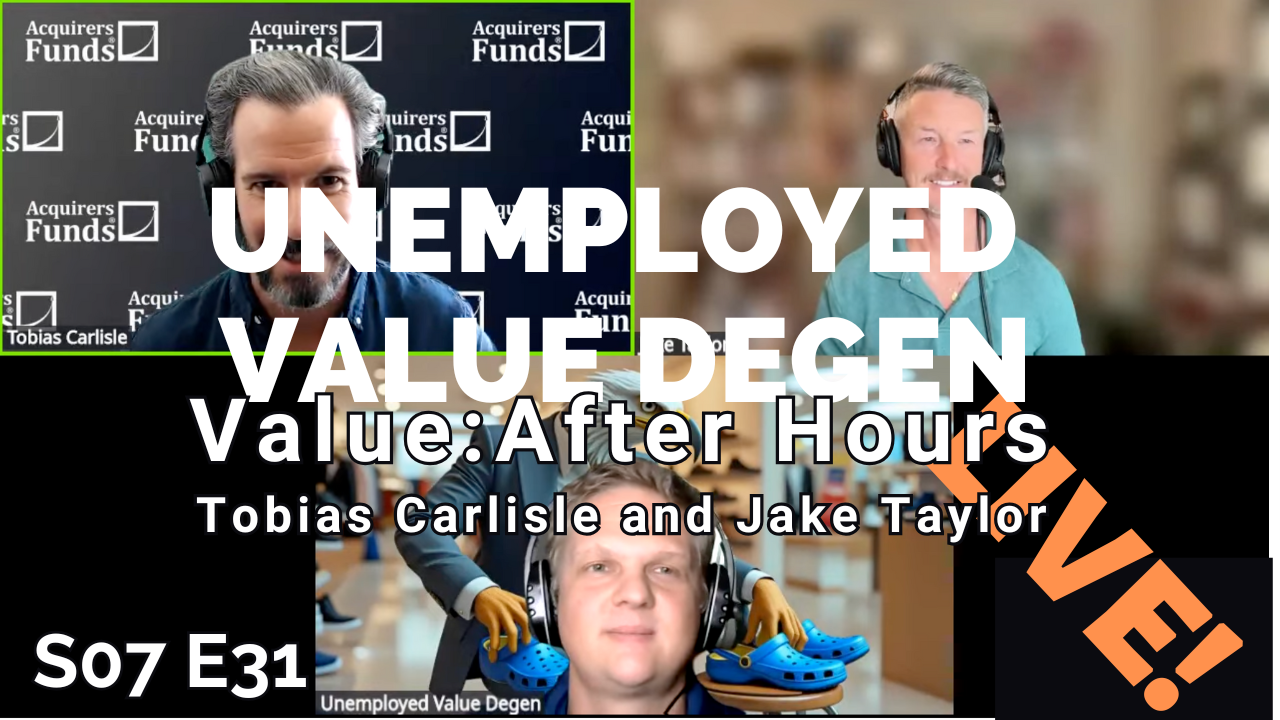
During their recent episode, Taylor, Carlisle, and Stephen Farrington discussed Insider Buying: Finding Signal in the Noise. Here’s an excerpt from the episode:
Tobias: So, tell us a little bit about your philosophy. How do you identify undervalued small-caps, and what are you looking for?
Stephen: Oh. So, it’s very hard to be a generalist, because every industry has their own metrics that matter. So, every time you try and crack into a new industry, you’re really grasping in the dark. I have gravitated more towards price to sales than price to earnings, because there’s just so many accounting tricks people can use to manipulate earnings. It’s much harder to manipulate sales and revenue.
But one of the first places I look– This ties into my background a little bit. I was a former professor. I’ve been through all the classes for the PhD program and I’ve had way too much math. I really love insider buying. But when you speak to people that do the multivariate regressions, they say, “That doesn’t add anything to the model.” One of the problems with the people that use huge data sets, is they always assume that more data is better. And sometimes the parsimonious model is the best one.
If you take all insider behavior, you’ve got a lot of noise in there. For one thing, just forget about the insider sales, because most of the time you’re dealing with management who considers that part of their salary and selling is what’s supposed to happen. And you have other times.
There was a Scandinavian company, I remember. The CEO sold half of his position and the market was terrified about it. He even came out with a press release. He said, “Sorry, guys, I’m going through a divorce. I still believe in the company.” [Jake laughs] So, just forget about the sales and look at the buys, because there’s only one reason why somebody that works at a company is going to buy stock in that company.
Even then, I ignore the directors, most of the time. Sometimes I’ll check out the biographies of the directors and see if they really have good experience that industry. But I would ignore the insider buying from independent directors, and even the chief executive officer. So, one of my PhD advisors– This was her area of research.
Chief executive officers, if you look at them, there is an advantage to managing a company with a chief executive officer who is consistently wrong, but he’s biased optimistically. So, if you have a CEO that says, “Next year, we’re going to have full self-driving. Next year, we’re going to have full self-driving.”
Tobias: [laughs]
Jake: Whoa, who are we talking about?
Stephen: “Next year we’re going to have full self-driving.” So, CEOs that are consistently wrong, but are wrong overshooting their estimates. Their engineers produce more patents per engineer.
Jake: Because they believe it’s possible.
Stephen: There’s this huge advantage to leadership. Yup, you got to make people believe. So, CEOs have to make people to believe. And in making people believe, they believe. So, I love to ignore CEO buying and director buying. I go straight to the most pessimistic bean counters. I want to see, when is the CFO buying?
Tobias: [laughs]
Stephen: And even better, when is the general counsel buying? Because you take the most pessimistic people in the building that have all the information to know where all the bodies are buried and know where all the risk is. And if I see a chief financial officer take $300,000 out of their checking account and buy stock in a company, and I see the general counsel take $200,000 out of their checking account and buy stock in the company, then I’m engaged.
So, maybe on average, insider behavior is noise. But within that noise is a lot of signal if you know that the parsimonious model is sometimes more correct. So, that’s insider behaviors. Maybe my most favorite screen, especially for being a generalist and not knowing so much about every industry.
Jake: I’d be curious if you could move that to even, like treasurer or the comptroller. Because it’s like, “Okay, the cash is real.” [chuckles]
Stephen: Yup, exactly. Chief operating officers are pretty good too. But you just have to know the CEO. He can be wrong. He can believe he can drink the Kool Aid. And directors, they could be doing a better job. But there is real hard kernels of data in the insider behavior, and it has worked out well for me in the past.
Tobias: I think that’s a pretty clever hack, actually, because as a former general counsel, I can confirm that the CFO and the general counsel are the most pessimistic guys in the building.
You can find out more about the VALUE: After Hours Podcast here – VALUE: After Hours Podcast. You can also listen to the podcast on your favorite podcast platforms here:

 Breaker

 Overcast


 RadioPublic


 Stitcher

 Undervalued Private Credit Investing: Finding Value in Discounted Lending Funds
 Where Is the Deep Value in Canadian Stocks This Week?
 Investing Beyond AI: Why Traditional Businesses Could Still Thrive