
VALUE: After Hours (S07 E30): Voltaire’s Bond Lottery Arbitrage
Thursday, September 11, 2025 · Johnny Hopkins
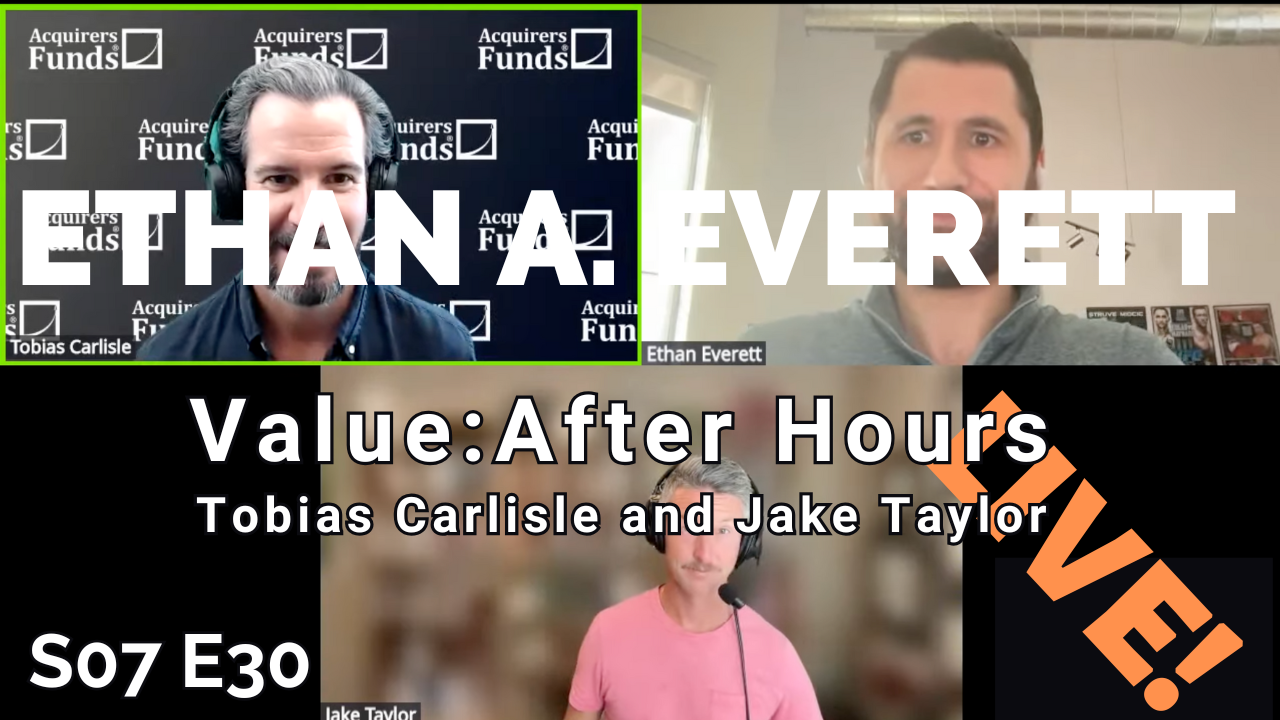
During their recent episode, Taylor, Carlisle, and Ethan Everett discussed Voltaire’s Bond Lottery Arbitrage. Here’s an excerpt from the episode:
Tobias: Let’s talk Voltaire.
Ethan: Oh, boy.
Tobias: This is the one I like. How did a success in the bond lottery arbitrage shape his writing and his worldview?
Ethan: So, this was probably the most exciting for me, because– First of all, so, I will say they got to make a Hollywood movie on this guy. I don’t know who’s going to be the actor, but this story is just– in my opinion, it’s made for Hollywood. So, if any producers are listening. So, for Voltaire-
Jake: They’re not.
Tobias: [chuckles]
Ethan: Yeah, they’re definitely not. Yeah, wishful thinking. But for Voltaire, he grows up as not in a bad situation, but he’s the son of a civil servant. I believe his dad is a scribe or something. He wants to be able to say things, but he can’t necessarily say everything he wants to say. He has to be careful in what he writes, because he can’t piss off royalty, he can’t piss off the duke of blah, blah. blah.
Anyway, he has trouble restraining himself and ends up writing some stuff that pisses a lot of people off. I think he wrote something that called out the Duke of Rohan’s son, and this led to him being exiled into England for I believe it was two years. He was supposed to be in jail, but somehow, he was able to finagle getting exiled for two years into Britain. While he was there, he got to read some really enlightening stuff. He’s talked to Shakespeare, Isaac Newton. I think there were some people who talked about he might have been at Isaac Newton’s funeral. I’m not sure about that.
But anyway, he comes back to France and– He’s in this position where he has to watch what he says. He just got back from exile and he happens to meet this mathematician, this famous French mathematician who points out to him a flaw in the bond lottery of France. I want to try and give– I’ll give very quickly, what do I mean by bond lottery? Okay, so, very quickly–
This was actually somewhat common in Europe. But very quickly, there was a time the government of France had borrowed– They actually borrowed through the city of Paris as a conduit. But anyway, they ended up defaulting on their debt and the bonds were trading at some tiny fraction of face value. They wanted to be able to somehow push that price up, so that other people would be willing to invest in a new issue of bonds. So, they had this crazy idea that they were going to say, “If you own these bonds, these ones that we defaulted on, you get a ticket to this lottery. And the prize of the lottery, is that your entire bond gets paid off in face value.”
Tobias: [laughs]
Ethan: Again, given that these things, let’s say they’re trading at 10 cents, 20 cents on the dollar. I forget, I did some research on what it actually was. You know this would be a big windfall.
I guess the mathematician figured out that if you bought up all of the lottery tickets, the expected value was actually higher than the cost of those tickets. The math is interesting. I ended up going through it, but long story short, Voltaire makes a ton of money. Enough money to build a body of wealth that enables him to say what the heck he wants for the rest of his life. He really, really gives it to the establishment in terms of whether it’s religion, government, you name it. But now, he had the money to buy protection and have the influence to say what he really wanted to say.
So, yeah, talk about arbitrage, leading to one of the most prolific writers of the past 500 years. Yeah, I think that definitely you could say bond– We might not have had some of these great works had it not been for bond arbitrage.
Tobias: So, there’ll be a summer blockbuster coming to you soon. John Cena as Voltaire. The Rock?
Jake: The Rock as Voltaire. [laughs]
Ethan: You think the Rock?
Jake: No, it’s going to be like-
Tobias: John Cena.
Jake: Timothée Chalamet.
Tobias: The Rock’s playing Isaac Newton.
Ethan: Timothée– That is spot– I like that. That’s spot on. Unless you want a jack Voltaire, then that’s not going to work.
Tobias: Let’s talk a little bit about Voltaire and his approach, how that applies to investment.
Ethan: So, he always had this cynical attitude towards everything in life, whether it was people, their motives, institutions. He writes about stock exchanges as a way of basically no matter how good or bad different people are, it connects people, and aligns their incentives and leads to good results. He talks about how on a stock exchange, it doesn’t matter if you’re Jewish, Muslim or Christian, the only person who gets called a heretic is the person who’s bankrupt. I love that quote. So, I think that he sees investing or financial exchanges as a really positive force in society.
More so how does it connect to investing? I think talking about his attitude towards investing, when he came across this opportunity for bond arbitrage, he had such a skeptical cynical tint to him that he was very, very willing to believe if the evidence was shown, yeah, the government could mess up. This could absolutely be a possibility. Markets aren’t necessarily efficient. Not that he was talking about it in terms of efficient market hypothesis back in those days.
But again, I think the way it connects to investing, is what is your outlook on the efficiency of markets. I think for people that are raised to be skeptics from a young age and not just accept the status quo, you’re more likely to be comfortable with this idea of challenging the efficiency of markets. Listen, something like arbitrage, where it’s just clearcut inefficiency, some people will say, “Oh, the $100 bill on the ground can’t be real, because someone would have picked it up already.”
But I think that for investing, I think while you need to question yourself and your capabilities, if you can’t fathom that there’s going to be large inefficiencies in the market, you’re unlikely to find them in the first place. You got to have your eyes out. It’s typically the skeptics, the cynics, the people with Voltaire who write stuff that pisses people off that are of that type. I don’t want to compare Bill Ackman and Voltaire. But again, that type of person who might write something that pisses people off, those are often the people are there to find those inefficiencies.
Jake: Voltaire’s books are shorter than Ackman’s tweets. [chuckles]
Tobias: [laughs]
Ethan: I actually believe one of his tweets was about the length of his entire Candide novel.
[laughter]Ethan: So, that’s not true. [chuckles]
You can find out more about the VALUE: After Hours Podcast here – VALUE: After Hours Podcast. You can also listen to the podcast on your favorite podcast platforms here:

 Breaker

 Overcast


 RadioPublic


 Stitcher

 Undervalued Private Credit Investing: Finding Value in Discounted Lending Funds
 Where Is the Deep Value in Canadian Stocks This Week?
 Investing Beyond AI: Why Traditional Businesses Could Still Thrive