
VALUE: After Hours (S07 E30): Spinoza and Emotional Bondage in Investing
Monday, September 8, 2025 · Johnny Hopkins
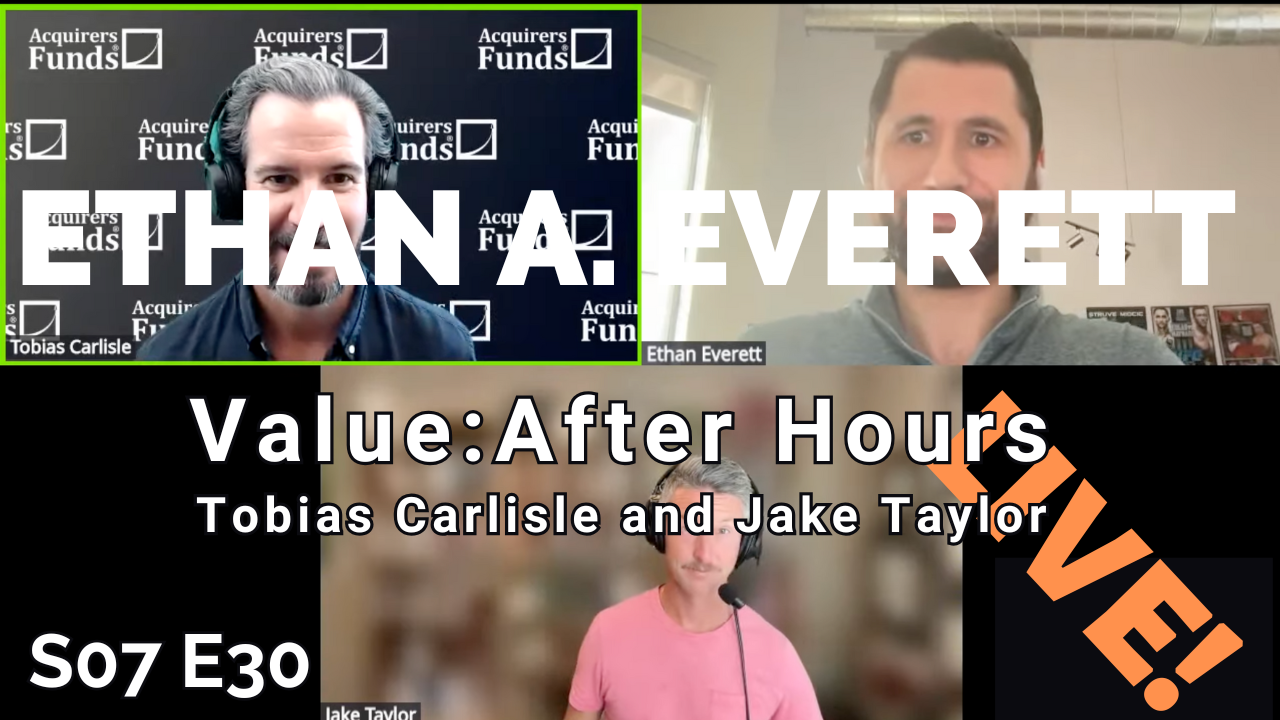
During their recent episode, Taylor, Carlisle, and Ethan Everett discussed Spinoza and Emotional Bondage in Investing. Here’s an excerpt from the episode:
Tobias: Tell us a little bit about Baruch Spinoza and irrational emotions, how they explain the stock market.
Ethan: Fantastic. Yeah. So, Baruch Spinoza is a really interesting thinker. Just to give a tiny bit of background, he’s born into the Jewish community in Amsterdam. This is in the early-to-mid 1600s. He ends up saying some things that the Jewish community wasn’t too happy about, like, God equals nature, and the Bible was written by people. Anyway, he ends up getting excommunicated. So, nobody really wants anything to do with him. So, he starts writing stuff that nobody else really is willing to say.
One of the things he talks about, is that fundamentally humans have certain things that they’re not in control of, these irrational emotions, but he believes that if you recognize them and do this introspection, somewhat similar to what the current mindfulness movement does, you can have a better life.
He basically says the more that you see your own emotions, your irrational emotions, the more you can be in control of them, or not in control of them, but actually adjust to them. I think that Daniel Kahneman is really interesting, because he’s almost a modern version in some ways of what Spinoza is saying, you know, this type one versus type two thinking. I think what Spinoza is advocating, and not to put words in his mouth, because– This is the hard part, because I don’t get to ask Spinoza, “Oh, is this what you meant when you wrote this in Latin?”
I don’t get to ask that. But my thought is that in a way that if you think of it from a Daniel Kahneman behavioral finance perspective, you sometimes want to take your type one natural thinking that just happens and move it towards type two. Use different processes that require you to reflect on things, whether it be post mortems after you do a certain investment, whether it be having a dialogue with someone else to reflect upon your ideas.
So, I think that Spinoza believes that we should be doing that with everything in our lives. He says that if we don’t do that, we’re in bondage to our emotions. He uses that term, bondage. So, he thinks that we’re slaves to our emotions, but the most high pursuit that we can do is to use reason to transcend that. I love that just in terms of life. it’s, first of all, much easier said than done. [chuckles] It’s really easy to say, “Oh, be rational. Reflect on your irrational emotions.” Easier said than done. But I think in finance, I think it applies tremendously.
Spinoza’s life, and I can talk about this later, his life was really shaped by this giant, what you would call the largest public company ever. People think Nvidia is big on an inflation adjusted basis, the Dutch East India Company. I’ve seen different estimates. Some saying that the market cap would be $10 trillion today. I think I had in the book which was written– This was like a year or two ago, I had $7.5 trillion. Estimates vary, but he lived in a place where the impact of a public company was inescapable.
Jake: Toby, what have you done to try to control your emotions in investing?
Tobias: Yeah, I’m entirely systematic. I couldn’t agree more with the approach. Spinoza’s right on the money. What do you think, JT? What have you done?
Jake: I still hold out a little bit of wiggle room for intuition, which I think might be classified as subconscious pattern matching. But I think it just has to be done carefully and in places—You probably need to catalog it and record it and then actually follow up to see where and when can you trust that intuition and where shouldn’t you.
That’s where I think there’s a little bit of a breakdown in that learning loop is that people don’t do enough recording of these intuitions. They just have a gut feeling and then they go. Or, they have a gut feeling and then they go try to back solve with all the numbers and logic that they can to get to where they wanted to go to begin with from the gut feeling. So, that post-hoc rationalization.
Tobias: There was a good article– I think it was Malcolm Gladwell about Taleb. And Taleb used to ask his analysts or his researchers, probably Spitznagel, every day when he came into the office, “Have you introspected today? Introspect.”
Ethan: Really? I will say, Taleb– Well, if somebody’s written on the connections between philosophy and investing, I do have to give him credit. He’s been quite philosophical in his book. So, I should have given credit there as well. That’s a good–
You can find out more about the VALUE: After Hours Podcast here – VALUE: After Hours Podcast. You can also listen to the podcast on your favorite podcast platforms here:

 Breaker

 Overcast


 RadioPublic


 Stitcher

 Undervalued Private Credit Investing: Finding Value in Discounted Lending Funds
 Where Is the Deep Value in Canadian Stocks This Week?
 Investing Beyond AI: Why Traditional Businesses Could Still Thrive