
VALUE: After Hours (S07 E30): Nietzsche, Buffett, and Eternal Recurrence
Tuesday, September 9, 2025 · Johnny Hopkins
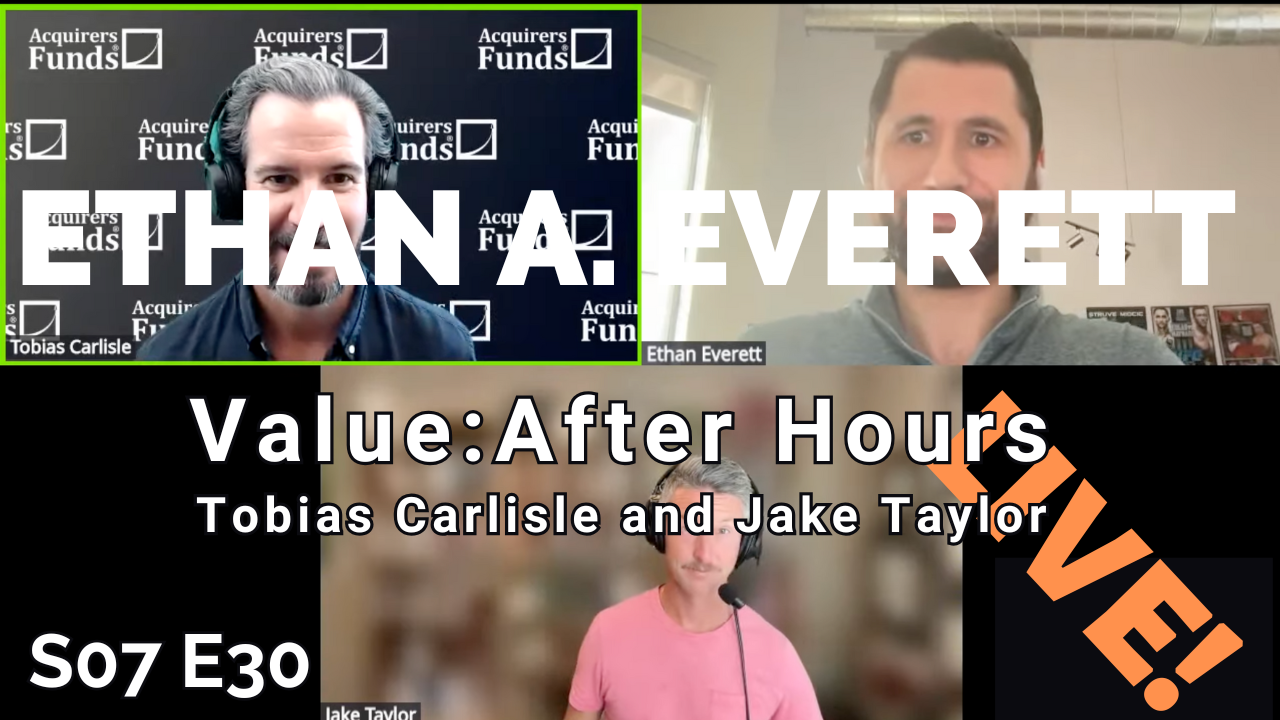
During their recent episode, Taylor, Carlisle, and Ethan Everett discussed Nietzsche, Buffett, and Eternal Recurrence. Here’s an excerpt from the episode:
Tobias: You’ve also covered one of my favorite philosophers, Nietzsche, and you connected him to Warren Buffett. What common ground do they share?
Ethan: So, this is an exciting one for me, because at the end of the day, listen, we’re all Buffett fans here. There’s so many things that just felt were played out. And I said, “Is there anything new I can do in terms of a Buffett connection?” I said, “Has anyone ever taken Nietzsche?” Because for me, it wasn’t just about Buffett’s investing. It was about his morals.
I actually, in college, remember having, on my dorm room, I had a poster that said, and I’m going to watch me misquote it, “It takes 20 years to build a reputation and 5 minutes to ruin it.” In the backdrop of my head, I always thought about Buffett’s investing, not just in terms of its financial success, but also in terms of he has this morality that just seems to come naturally to him, that he’s doing the right thing.
I looked through his writing, and what I found was the key core base of that morality was this. If you’re uncomfortable seeing something in the front page of the New York Times or you’re uncomfortable having a skeptical, yet intelligent reporter asking you about it, then you probably don’t want to do it. And that just felt very Nietzschean to me. Why? Specifically, because of this idea of eternal recurrence.
So, Nietzsche, just to say really quickly, he didn’t like the idea of, “Oh, you do good stuff, you go to heaven forever. You do bad stuff, you go to hell forever.” He said that that wasn’t going to lead to a– Actually, good morality because you’re being selfish in a sense, you’re just doing it, so that you can have this great situation forever. He thought to himself, is there a way that we can have this thought paradigm about our actions and what good and bad is without being selfish.
His idea was this idea of eternal recurrence, which was basically this thought experiment where you say, “Okay, everything I do is going to be repeated again and again and again forever.” If you’re not comfortable with your action repeating again and again and again echoing in eternity, then it’s probably not something you should do. Because a lot of the times when people want to cut corners from a moral standpoint, it’s like, “Oh, I’ll just do it this one time.” But Nietzsche’s idea transcends that, this idea that our actions echo in eternity, I thought, wait, that’s somewhat similar to what Buffett is saying. He’s trying to find a way to basically see how– He’s trying to create some thought experiment to make people really, really reflect on the morality of their actions.
And so, for Nietzsche, it’s echoing in eternity. For Buffett, it’s reading it on the front page of a newspaper. But that kind of reflection to think of morality that way, I thought was a really, really interesting connection. And then, I make some more connections. They both talk a lot about what makes value in life. Clearly, Buffett and Nietzsche as well do not see financial success as the all-encompassing measure. I think Buffett said in a Georgia Tech speech that “If nobody loves you by the end of your life, you’re probably not that good of a person.” [chuckles] He said, “There’s people with hospital wings named after them, but nobody would actually want to say anything good about them.” He says, “That’s not what you want.” Nietzsche talks about this as well, that there’s people that have financial success that are just not of a high-quality from a moral standpoint.
Jake: Happy 95th birthday to the GOAT, by the way, this weekend.
Tobias: Wow, that’s a good knock. Yeah, I like the idea of eternal recurrence as a risk measure. If there’s anything that you do with a downside that’s big enough and you do it enough times, eventually that even though it’s very remote, that downside catches up to you. You can fit morality into that too if you do something bad enough, it catches you.
Ethan: Listen, if people haven’t had too much of me already. But if there’s so many of these ideas, I didn’t even think of that. I talk about this in my preface. I’m excited for other people to start making philosophical connections to investing, because that’s a great example, eternal recurrence from a risk. Because sometimes people think, “Oh, I can take this one-off risk and get away with it.” But when you think about it from an eternal recurrence standpoint, that’s actually a really, really interesting thought tool.
Tobias: Well, if you take a one-off risk, it becomes habitual too. And eventually, that collection of one-off risks, you start seeing the underlying probabilities play out in your own life.
Ethan: Absolutely.
You can find out more about the VALUE: After Hours Podcast here – VALUE: After Hours Podcast. You can also listen to the podcast on your favorite podcast platforms here:

 Breaker

 Overcast


 RadioPublic


 Stitcher

 Undervalued Private Credit Investing: Finding Value in Discounted Lending Funds
 Where Is the Deep Value in Canadian Stocks This Week?
 Investing Beyond AI: Why Traditional Businesses Could Still Thrive