VALUE: After Hours (S07 E30): Net-Net Skepticism and Avoiding Scams
Thursday, September 11, 2025 · Johnny Hopkins
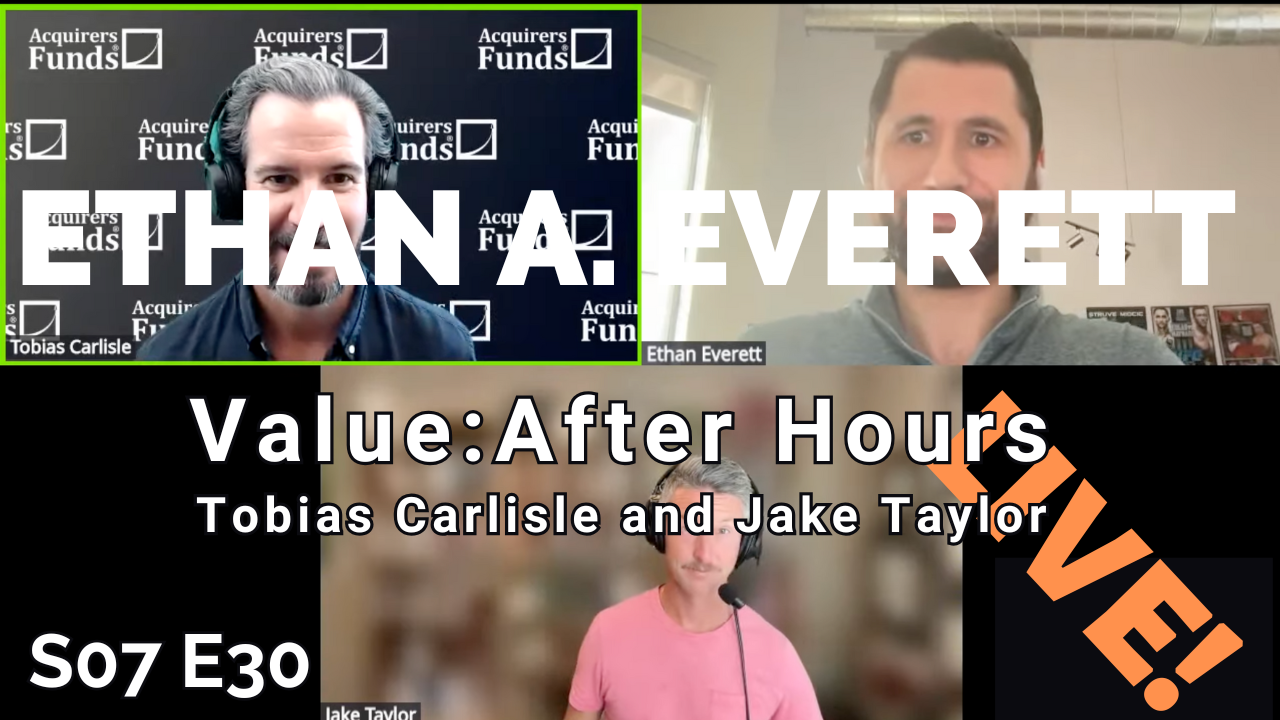
During their recent episode, Taylor, Carlisle, and Ethan Everett discussed Net-Net Skepticism and Avoiding Scams. Here’s an excerpt from the episode:
Tobias: You had a good line in here about net-net skepticism and how investors can profit from that, so given that I love net-nets.
Jake: And I cannot lie.
Tobias: Let’s go, Ethan. Net-net skepticism.
Ethan: So, I think net-net skepticism speaks to what I was saying earlier with Hume, that at the end of the day, net-net, what is your opinion on this thing? You can take a skeptical stance, but then you have to make all sorts of considerations, whether the liabilities or whatever it is. You have to account for all these things, these off-balance sheet things, so to say, what is the net-net value of your insight or of your investment thesis taking into account everything, not just the clear assets, cash liabilities. Is there some legal liability hanging around there? Is there some off balance sheet, pension, underfunded?
I think that for me, it’s your skepticism investing needs to be net of a lot of things. Just like, when you’re actually looking for the cash value of a cigar bud, you got a net-net, what are you actually getting. What’s the cash burn? It’s not always as simple as just looking at, all right, current assets minus current liabilities, and there it is. There’s often a lot more to be dealt with.
Tobias: That’s like overcoming your skepticism to buy something. But what about the reverse situation where you’ve got– What philosophical principles help you to not invest with somebody like Madoff? Like, how do you suspend the belief there?
Ethan: So, I specifically talked about–
Jake: Common sense.
Tobias: [laughs]
Ethan: Definitely common sense. It’s funny, because I actually saw– So, I had an example about Ken Langone, the co-founder of Home Depot. Basically, he had Madoff, and this is a true story, came to him a month before the collapse and basically told Ken Langone, “I’m going to give you this incredible deal. I’m not giving it to any of my other clients.” Langone tells this story. He says, he was just uncomfortable with the idea that, “Wait, if you’re screwing your existing clients, now what are you going to do to me? That’s not right. I don’t feel comfortable with not giving them the deal. These people have been with you for years and you’re just going to give this to me?”
Jake: There’s a saying that when a man marries his mistress, a new position opens up.
Tobias: [laughs]
Ethan: I love it. I love it. Basically, he saw that and I actually compared that to there’s a philosopher named Martin Buber who would seem to have nothing to do with markets, but he had this philosophy of the way we interact with the world, whether it be other people in the investment world, whether it be friends, family, whatever. We have two fundamental ways of relating. One is where the other person is a fundamentally worthy conscious being and the other where you treat somebody like an object.
He didn’t say this, I’m making this connection. I’m basically saying that if you treat other people in the market, for instance, the other side of the trade, as worthy beings, not just people to be dismissed like, “Oh, these are the idiots. This is the dumb money on the other side of the trade,” you’re going to be in a lot better position. I think that understanding that there actually is somebody, a real person on the other side, that was something that really helped Ken Langone specifically not invest in Madoff.
Now, I’m not going to say I would doubt Ken Langone’s ever heard of Martin Buber, but again, I think that that idea that combined with skepticism can be very potent for not getting scammed.
Jake: Apparently, there’s a saying in the MLB, the pros, that you know the other guy lives in a big house too.
Ethan: Right.
You can find out more about the VALUE: After Hours Podcast here – VALUE: After Hours Podcast. You can also listen to the podcast on your favorite podcast platforms here:

 Breaker

 Overcast


 RadioPublic


 Stitcher

 Undervalued Private Credit Investing: Finding Value in Discounted Lending Funds
 Where Is the Deep Value in Canadian Stocks This Week?
 Investing Beyond AI: Why Traditional Businesses Could Still Thrive