
VALUE: After Hours (S07 E29): Microcap investor Jason Hirschman on his method, $XPEL and the Buffett salad oil scandal
Sunday, August 31, 2025 · Johnny Hopkins
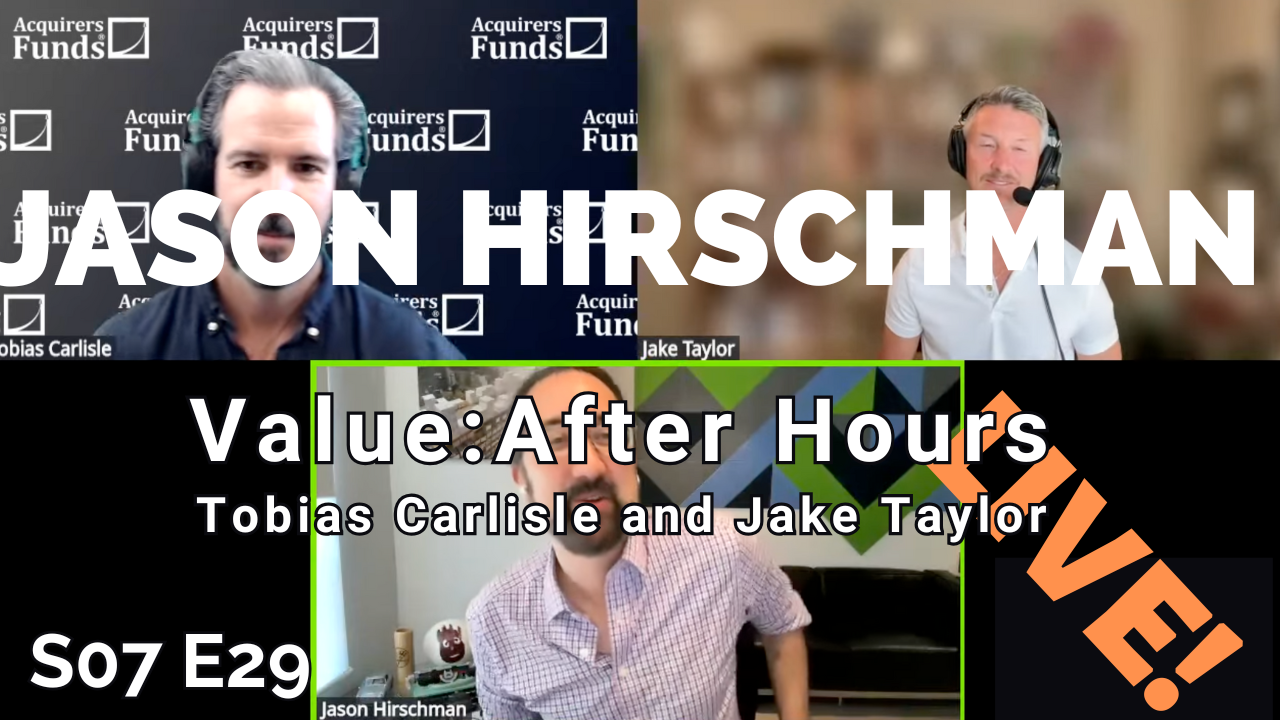
During their recent episode, Taylor, Carlisle, and Jason Hirschman discussed:
- From Family Business to Hudson 215 Capital
- The “Salad Oil” Approach to Investing
- Blending Value and Growth Opportunities
- Lessons from the XPEL Investment
- Why Micro-Caps Attract Me
- The Substack and AI Revolution in Micro-Cap Investing
- Expanding Opportunities Abroad
- Red Flags and Lessons Learned
You can find out more about the VALUE: After Hours Podcast here – VALUE: After Hours Podcast. You can also listen to the podcast on your favorite podcast platforms here:

 Breaker

 Overcast


 RadioPublic


 Stitcher

TRANSCRIPT
Jake: And we’re live.
Tobias: I think we’re live. It’s hard to tell. It says it’s still setting up your meeting for YouTube Live. So, I guess it’ll let me know at any moment now. In any case, it’s Value: After Hours. I’m Tobias Carlisle. Joined as always by my cohost, Jake Taylor. Our special guest today is Jason Hirschman. Hudson-
Jason: Hudson 215 Capital.
Tobias: -2-1-5? 215 Capital.
Jason: 215. 215.
Tobias: Thank you.
Jake: Jason, welcome. It’s good– You and I have become friends over the last couple years. So, it’s exciting to have you on the show.
Jason: No, I really appreciate being here on the show and really excited to talk about what’s going on out there.
Tobias: Jason, you’re well known in the value community, the small-cap value community particularly. Perhaps, not so much to the broader community. Rather than me give you an introduction, why don’t you tell us in your own words how you became Hudson Capital 215.
Jason: Hudson 215 Capital? Sure, sure.
Jake: Is the small-cap value community in the room with us, Toby?
[laughter]Tobias: Yeah. I’m all– [crosstalk]
From Family Business to Hudson 215 Capital
Jason: It’s in the room. It’s in the corner over there. Yeah, absolutely. Well, let me just give a little bit of background about myself. I was involved in a small family business from 1996 to 2022. Started to focus 100% on investing. We have family office, the Hudson 215 Capital. I’ve been investing since my early 20s. It’s been fun turning five figures into six, then seven, then eight and now nine figures.
The “Salad Oil” Approach to Investing
So, guys, I think your audience has probably deeper knowledge of Berkshire Hathaway than any other financial podcast in the developed world. [Jake laughs] So, I think I can reduce my approach to two words that every hardcore Warren Buffett fan knows. And those two words are salad oil. I’ll say it again, because every hardcore Buffett– I heard the little nod there, so you know those words, salad oil.
But for every Gen Z listener who hasn’t memorized all the old school Warren Buffett stories, okay? What was the Salad-Oil scandal? So, back in 1963, America Express had an asset lending operation that made a large loan to Allied Crude Vegetable Oil refining backed by tanks of vegetable oil. Unfortunately, Allied deceived American Express and others by filling those tanks primarily with salt water and a thin layer of veggie oil on top.
So, when the scandal broke, Allied went bankrupt. American Express was hit with claims almost equal to its end of year 1963 market capitalization. But Amex’s warehouse lending business was incorporated as a separate entity. So, Buffett conducted great due diligence and made sure that Amex’s for travelers checks, and budding credit card operation had not lost the confidence support of retail customers, businesses and banks. It had not. So, Buffett’s partnership bought 5% of American Express as it fell in reaction to the scandal.
Salad oil investing, or as I sometimes put it non-operational turnaround investing, is buying a publicly traded stock when the valuation is being hit or held back by something outside its core business operations. I’ve done it with XPEL in 2016 because of the 3M patent lawsuit. I’ve done it with alternative asset managers in 2013 and later actually when their K1 partnership structures kept valuations low. I’ve done it with CME and MasterCard which were far from profit maximizing prior to IPO’ing because of their cooperative ownership structures.
I think there are two other lessons I think from the Amex salad oil scandal which I think are crucial for fundamental investors. First, value investing to me isn’t necessarily low PE or low price to book or low price to cash flow. I’ve read that Buffett bought this Amex stake in 1964 between $35 and $38, but also read that his Amex position was bought, let’s say closer to $41 per share. So, Amex reported $2.52 in earnings in 1963. Before the salad oil scandal, the stock was trading around $63. Even at Buffett’s purchase price, Amex was trading in line with the S&P 500 at the time.
Blending Value and Growth Opportunities
Second, should you be a value investor or growth investor? I think the best opportunities tell you the answer. Value of growth? I think the answer is yes. Again, consider American Express when Buffett bought it in 1964. Travelers checks and money orders were its top two segments. But you’ve got this amazing young credit card operations too. Actually, I just want to read you a few lines from the 1964 Amex annual report about the credit card operation, because I think they’re hilarious if you geek out on investing.
For the American Express credit card, 1964 was a year of unprecedented growth. Billings total $344 million, a remarkable 42% increase over $242 million billed in 1963. Total number of cards in force at the year-end increased 20%. This is the money line. These increases were the largest of the last five years, strengthening our conviction that the market for this comprehensive credit instrument is far from saturated [Jake laughs] in 1964. It’s just hilarious. To me, when you get these rare opportunities, combining value and growth as I experience with XPEL, you have to take advantage. You have to follow the bottom line, be greedy when others are fearful.
Now, when I use this a few performance figures, my younger son’s UTMA to illustrate four mentioned points. I’m using his account record, because it’s a bit less concentrated, more conservative and the cash flows are frankly just easier to track. I’m not going to refer to the real dollar amounts, but I’ll use real percentages and ratios. We put a dollar in mid-2006, a dollar each in January 2007, in 2008 and 50 cents in January 2009. So, $3.50 invested in four different calendar years.
In the S&P, dividends reinvested, that $3.50 turns into about $23.65 as in the end of June of this year. No taxes, ETF, management fees or withdrawals apply. The 2006, 2007, 2008 dollar CAGR in the 10s or so, that lucky 50 cents invested in early 2009 earned about 14.6% through June in the S&P 500.
Now, my son’s portfolio turned that $3.50 into $70 at the end of June. That’s about a 17.5% CAGR. By the way, that’s with all the dividends and realized capital gains taxes paid out of the account. Also, because we wanted him to have some skin in the game, we withdrew some of his upland money to pay for part of his private high school education. So, it’s really not apples to apples with the S&P 500. But there’s one hitch. Those returns are based on the premise that his XPEL investment went to zero. That did not happen.
So, include those XPEL returns or the returns of positions purchased with his after tax XPEL proceeds and the portfolio turns $3.50 into $130. So, that’s about a 21.7 CAGR or net of tax realized in gains. Despite some tuition withdrawals from mid-2006 through June 2025, I think it’s a pretty solid job.
Now, this is a portfolio that holds XPEL, but it also holds Blackstone, Apollo, Ares, The Alts, MasterCard which we bought in 2006, Visa which we bought in 2010, CME, ICE from 2008 and some micro-caps and small-caps like a company called Hype and THEON and Nordrest. And a few other micro-caps and small-caps, I just can’t disclose today. So, I think this is like a salad oil investing portfolio and I think it can be applied to all sorts of assets.
For my son’s UTMA, my goal was an 80/20 result. 80% of investments should outperform the S&P 500. So, this was like a later entry, lower risk but also lower reward approach. So, I’ll pause there. I certainly want to talk about why I like micro-caps and small-caps, and also why I see the opportunity set going forward, at least for me, which makes my historical returns difficult to replicate. But I can go on and talk about micro-caps or we can pause and see maybe where some of your listeners are handling from today, Toby.
Jake: I thought the 80/20 was 80% of the portfolio has to do better than 20% IRR.
[laughter]Jason: Yeah, it’s maybe historically worked out that way, but I just want to put a little context. I know there’s so many professional investors come on and they can’t talk about their records. I just have my own just family money. So, I thought maybe just put out there at least one account, give people a little bit of context. Also, to show that sometimes the difference between 17% and 21%, just a few percentage points. But over time, it really adds up the difference between $70 and $130. It’s a dramatic difference. But happy to talk about micro-caps and small-caps, if you don’t mind.
Tobias: Jason, let’s just talk about– Amex was going through a crisis not related to its main business. It was the secondary business, where they were issuing warehouse receipts for oil they supposedly had stored in their warehouses. Meanwhile, they’ve got this credit card franchise. The question for Buffett is, are people still accepting the credit cards? Because now, potentially, there’s this credit risk that this vendor doesn’t get paid. And so, they’re like, “Ah, do we continue to accept this or not?” He goes and sits in restaurants and discovers that people are basically completely oblivious to this thing going on, and so he thinks it’s a pretty good bet.
Lessons from the XPEL Investment
My question is for XPEL. So, XPEL is a slightly different situation where it’s a newer business. They have similar crisis, but more directly related to their core business. So, how did you think through the XPEL issue and the crisis? Can you just talk to us a little bit about XPEL?
Jason: Yeah, I think we could talk about XPEL. What I can say, is that I was very fortunate to team up with another investor, Lock, Stock & Barrel, who was also a micro-cap club member, who’s also a patent attorney. And in my business life, I submitted my first US utility patent application at age 21. I’ve sued and been sued for patent infringement. So, we made a good team.
By the way, I always say Lock, Stock & Barrel deserves the lion’s share of the credit for or XPEL. So, what we did to try and understand the situation better, we bought samples of XPEL paint protection film after 3M sued XPEL, we sent it out to a laboratory to be deconstructed, determined that XPEL film did not violate 3M’s patents, and further determined through our own analysis that 3M’s patent is a paint protection film patents were very weak. See, those two things determining the three M’s patents, which are very weak and also determining that XPEL’s film did not violate 3M’s patents gave us a lot of confidence.
Now, 3M is a giant, right? XPEL was a tiny company. So, there’s always the potential that even if you have all the facts on your side, things can go wrong. As you probably know, Buffett sized the Amex position, I think, around 18% or so of Buffett partnership. Honestly, I did the same thing with Amex. I sized it about 18% of my assets at the time. But I could tell you that after I received that chemical analysis report in mid-April 2016, I really stepped up my purchase of XPEL shares the day I received that report. So, from April 13th, 2016, through November 25th, 2016, I personally purchased 40% of the XPEL shares that traded on its primary exchange, the venture exchange up in Canada.
Now, that sounds like a lot, but 40% of 1,600,000 shares is still not that many shares. Those 1,656,795 shares that traded over seven months or so, that only added up to $1.8 million.
Tobias: [laughs]
Jason: So, again, we talk about like micro-cap opportunity and illiquidity. There’s so many people like– They love the XPEL story. Maybe the dream I wish I had XPEL. The opportunity was there, but it wasn’t huge.
The lawsuit went public on December 30th, 2015 through the end of 2016, there were 4.4 million shares that traded. But in the first 10 trading days, 1.4 million shares traded. But they were purchased so quickly after the lawsuit. Is that really investing or is that speculation in paint protection film sardines really at that point?
One of the things that I think people forget, is that it was very fortunate for me that…
Lock, Stock & Barrel that mid-2015 there was a bear market for micro-caps, particularly up in Canada. XPEL had disappointed unofficial guidance in late 2015, right before the lawsuit. So, in 2015, XPEL was trading above about $33 before the misguidance and micro-cap recession and lawsuit, which nothing would be wrong with 11 or 12 bagger to the current price. But it’s not the same as the 30 or 40 or 50 bagger. I have on my remaining shares even at the current XPEL price, because of that collapse, which gets us back to the importance. But I think every value investor knows of purchase price. Purchase price is so important even over a longer time period.
Jake: So, Jason, how then– I’m trying to think of a scenario where how do you get comfortable with the potential existential risk? Salad oil. He knew the business was still good, but what if there had been– You knew that it was kind of bulkheaded based on the corporate structure, but I’m thinking about maybe would be good–
Like, AIG for instance in 2008. You have a very good insurance business, but you have this derivatives trading arm that ended up bringing the whole thing down. How do you separate what’s actually an existential crisis– Like, could kill the company and what is more headlines? Other over and above just I guess due diligence and then position sizing for the managing that risk.
Jason: I’m going to give you an odd answer. It’s tied to the numbers. When I broke out XPEL, let’s say for my son’s UTMA and the non-XPEL, saying like, “Okay, what would happen if it went to zero?” I think ironically enough, like, if you people know they’re a pretty good investor and even if it went to zero, okay, I felt that I still could compound money at a very good rate. I wasn’t putting in 60% or 70% or 80%. I’m not one of these young Turks who just could put in 90% in there–
Jake: YOLO.
Jason: And YOLO. I was in the late 30s or early 40s, build up some assets. I can’t play Candy Land or whatever and go back to–
Jake: [laughs]
Jason: Or, shoot some ladders and go all the way back down anymore.
Jake: Yeah, take the ladder out.
Jason: No, I just can’t do that. Honestly, Jake, I don’t know if you know, that’s why you size things in some ways. There’s no way of handling all the risks. Everybody knows a level of concentration they’re comfortable with. I will say, there’s a difference between I think sizing it at cost like I did and also just letting it run after some of these things were resolved into a much larger position. No, but I don’t have a great answer for you, Jake.
Why Micro-Caps Attract Me
Tobias: I think that’s a pretty good answer. I like that approach to its sizing helps you deal with that sort of risk. Talk to us a little bit about micro-caps. What’s the attraction there?
Jason: That’s the attraction there. [Jake laughs] That’s the question that every–
Tobias: I run a micro-cap fund too, guys. I’m not–
Jason: Yeah, I understand.
Tobias: So, I’m really asking you like, why should– [crosstalk] [laughs]
Jason: What is the attraction? Let me come up with something here. Damn it.
Tobias: Help me out.
Jake: Yeah.
Jason: Help me out. When in doubt, always Charlie Munger something. So, let me invert the question-
Tobias: I love it.
Jake: Yeah.
Jason: -and say, what hasn’t changed in the micro-cap world over the past 10 years, and then I’ll talk a little bit about what has changed in the micro-cap world according to me.
Jake: That’s even better.
Jason: So, I think the micro-cap world, I think particularly in the United States and Canada still resembles Thomas Hobbes’ famous line like, “Nasty, brutish and short,” right?
[laughter]Jake: Yeah.
Jason: So, here’s some simple data from a screening and data tool that we use, like portfolio one, two, three. For the last fiscal year, I think there are about maybe 361 out of 500 S&P 500 companies that generate a return on equity of 10% or better. For micro-caps between $10 million and $400 million US dollars market capitalizations with their primary exchange in the USA or Canada, only 526 out of 3,154 generated an ROE of 10% or more. So, that’s 16.6% of companies. And frankly, those figures make micro-caps look good. There are 29 S&P 500 companies with negative common equity, but generated by positive net income. So, you’ll find companies like AutoZone or Lowe’s among them.
Jake: Yeah. Tons of buyback.
Jason: Bought backs. So much common stock over the years, the shareholder equity is negative and their ROE is basically infinite. But there’s companies like Pfizer, which maybe they earned a little bit less than a 10% ROE in 2024, but because of my sizable goodwill and intangibles on their balance sheet.
Now, among the 526 USA and Canadian market caps with ROE yields above 10, you’ll find 55 names with a positive ROE and a negative common equity. These are not auto sells. They are not auto sells. You’re seeing a perennially money losing company with negative shareholder equity with one year of positive accounting profit.
For example, there’s Victor Mining Group with a $50 million market cap and made $101,000 in net income in 2024 after years of losses and has a negative shareholder equity of negative $1.2 million. And for the record, I do not own any shares like Victor Mining Industry Group. I said, “Please don’t go out there and say Eight Track likes it.” You know? No. [Jake chuckles]
Okay. So, by the way, the ROE figures are not much improvable in larger micro-caps. But to be fair, these figures are used in reported earnings, which may or may not be helpful for some micro-caps and small caps. We’ll talk about that a little later. So, the ROE’s aren’t great. What’s also challenging is persistence. Even back then or now, a lot of micro-caps disappoint a good percentage of their investors who quite frankly expected more and faster than what they’re receiving.
Ian talked about this too a little bit, like micro-caps often string together a few quarters of top line growth, a few quarters of operating margin improvement. They race ahead, they hit the next pothole, and they bend an alloy wheel [Tobias laughs] and there they sit. So, they’re very well suited for six months to two year holding periods. And to be fair, at the right price, you can make good money buying a money losing unknown company that graduates to break even or profit mediocrity. You can make 3, 5, 10 times your money in some cases buying something that turns into a 10% ROE company. But to make that 10 times, I think you really probably had to exit when expectations were greater than a long-term 10% ROE biz. You’re taking advantage of that over exuberant expectation.
I think in some ways the fact many USA and Canadian micro-caps are so poorly suited for longer term investors. So, often given to fits and starts, so little populated with long-term winners, this actually creates an opportunity for investors like me. The greatest returning micro-caps over the long haul are rarely owned by those who originally owned their shares, because it takes different skills to know which micro-cap is worth suffering for.
The Substack and AI Revolution in Micro-Cap Investing
What has changed? So, micro-caps are particularly well suited I think for the investing Substack phenomenon. Everybody loves to read about a new name. There’s so many new to you names in the micro-cap space. You combine Substacks with ChatGPT, and it’s easier than ever to do research and publish respectable articles about micro-caps one after another.
I think it’s also another push pull dynamic. More attention, like additional investors chasing up the same name, potentially pushing up prices is not normally associated with higher long-term returns. But the micro-cap space is not the large-cap space. Microcaps in the USA and Canada, particularly Canada as a group are like net share issuers.
So, higher share prices could actually lead to lower levels of equity dilution for every dollar raised. It actually lowers the cost of capital for micro-caps. I’m just saying there’s a potential. The micro-cap community could see both higher share prices and more volume because of the Substack phenomena and a higher average daily volume also could open more names like more hedge funds. So, I think that potentially we could see a sorrow style reflexivity loop that helps micro-caps. Perception shaping reality which shapes perception and so on. That’s about how I see.
Jake: Like, lowering the cost of a good write up, then puts more companies on the potential menu of investors.
Jason: Yes. Yes. Substack and I think and AI are really changing things. Honestly, I think if you don’t mind, I have a– Where is it? Here. Yes. The high-tech technology here. [Jake chuckles] We got this chart here which I think you’ve all seen what I’ll just describe. It’s the Torsten Slok chart highlighting the 40% of Russell 2000 companies that reported negative trending 12 months earnings. We all know it. If you’re a value guy looking for evidence of an overvalued market, like maybe someone here, [Jake laughs] or if you’re a small-cap investor like myself, you’ve seen that chart, you know that chart, you think about it before you go to bed at night.
So, earlier, I highlighted some of the 10% ROE threshold figures for micro-caps in the S&P 500. Maybe it’s not as much meaning as it may seem. So, I want to give credit to Alger Asset Management for publishing an article. But what I believe is the most important academic paper for small-cap and micro-cap investors in many years. This paper has a really sexy title, Reassessed Earnings with Capitalized Intangibles.
Now, we all know that the percentage of company investment intangibles versus tangibles has been growing dramatically these past decades. GAAP treats tangibles and tangible investments very differently, expensing typically versus capitalized in many cases. Now, this wonderfully named academic paper, what it does? It capitalizes intangible investments and rightly offsets a portion of the advertising past intangible spending. So, the net effect is earnings as a percentage of revenue improves 900 bps. The effect is magnified for the small quartile stocks in the study, a 2,200 bps improvement.
Jake: Wow.
Jason: So, what that means is nearly 60% of the smallest quartile are reclassified as profitable from unprofitable, thanks to capitalizing intangibles. What’s also interesting to know was to me, is that the stock market performance of those gap losers but capitalized profitable firms produces returns 1,600 basis points higher than the overall universe in the study. And plus, since they reclassify intangibles, they ship them out of the vesting section of the [crosstalk] cash flow statement. Yeah, from the operating it also changes the operating cash flow to look much more impressive.
So, when I think what we have here in the near future, I think AI tools are going to allow investors to much more easily manipulate GAAP financial statements to unlock more accurate economic earnings. This is what micro-cap and small-cap have historically lacked, which is being remedied by AI and Substacks. They need effective but affordable tools to identify tiny stock opportunities and broadcast them to a wider audience. So, I think that’s really what is changing in the micro-cap world.
Right before quality stock coverage was something only the big boy firms covering big boy stocks could manage. So, to me, this is the biggest difference in the last 5 to 10 years for the micro-cap community. Of course, the big risk is illiquidity and cheap tools also attract charlatans of all sorts. So, we’re going to have to see how this plays out.
Jake: Yeah. The amount of noise that can be created is going to just go off the charts.
Jason: Yes. Right. You already see this, because human nature doesn’t change, right, Jake? I mean, all the tools can change. There’s always going to be a desire for someone who promises tremendous returns in a short period of time. If that attracts more eyeballs, if that attracts more subscriptions, then garbage in, garbage out.
Jake: Yeah. Or, you could camp out outside Drake’s house with a whiteboard too. I saw that. That seems to [Jason laughs] buy some– [crosstalk] [laughter]
Jason: There was some Twitter investor who wrote a thread about me just a few days ago, who characterized my XPEL investment as a thousand bagger. I corrected him and I said, “No, it’s not that.” But nobody reads down that, right?
Jake: It’s 950 at the most, guy.
Jason: Exactly. Exactly. [Jake laughs] I’m getting all this attention, I didn’t even have to take my clothes off. On one hand, it’s cool and interesting. But sometimes I cringe a little bit, because the important messages are being lost, about risk control, about importance of prices being paid, diversification at some level. These are all important things.
I started off reading a lot of John Neff. Nobody even knows who John Neff. You guys nod your head. Vanguard Windsor, at one point, the largest fund in the country. Nobody cares about these guys anymore. Just the three of us and about probably one-fourth of your listeners.
Tobias: Jason, we usually do at the top of the hour some veggies from Jake.
Jason: Please.
Tobias: I’ll do a quick shoutout to all the folks at home. Tallahassee. What’s up? Petah Tikva, Israel. Macs in Valparaiso. How’s it? Cleveland. Lausanne, Switzerland. Bethesda. Brandon, Mississippi. Lewis, Delaware. Thanks for spelling it out for me. [chuckles] Bremerton. Boise. Houston. Jupiter, Florida. Good on you, Sam. You’ve already won there. Bellevue. Nashville. Toronto. Snohomish. Nashville. Temecula. Sardinia, Italy.
Jason: Ooh. Okay.
Tobias: Poland. Hopefully, I’m saying these correctly.
Jake: There’s always the first time.
Tobias: There is a– [crosstalk] Gothenburg.
Jason: AI, Toby is going to pronounce them all correctly in about three years.
Tobias: God, wouldn’t that be great? [Jason chuckles] I’ll hit the beach. Jake chuckles] New London, Minnesota. Last one. All right, JT, hit us with the vegetables.
Jake: All right. Well, knowing that Jason was coming on and that he has a reputation that is perhaps not always as deserved as he was just saying, as far as being this micro-cap only investor. I knew that that wasn’t totally true either. But I wanted to focus on something in the smalls’ category of potential veggies. Maybe more like peas or something.
Let me set the scene. We’re underwater at a coral reef. Sharks are cruising by these shadowy submarines. Parrot fish are grazing leisurely on coral. A panoply of fish are just swimming around in this mesmerizing chaos of color and motion. And then, something quite strange happens. A shark slows down and hovers and then opens its mouth and into the mouth swims this tiny fish, and it’s called a cleaner wrasse. W-R-A-S-S-E.
Tobias: [laughs]
Jake: This bold little thing wiggles in, and starts nibbling parasites off the shark’s gums and gills. The shark doesn’t chomp down on it. It just waits patiently, almost like it had booked a dental appointment. What in the evolutionary world is going on here?
Before we untangle that, we will give you some fun facts about cleaner wrasses. They’re what’s known as sequential hermaphrodites. Meaning, most of them are born female. But if the dominant male disappears for whatever reason, the biggest female in the group will literally change sex and take his role. So, they’re bringing a whole new meaning to the term next man up.
The cleaner wrasses also punch way above their weight in cognition. Experiments suggest they can recognize themselves in mirrors, which is a sign of self-awareness. It’s quite rare in animals. Evolution gave them this sharper social intelligence, because their livelihood really depends on reputation and trust. There might even be clues in our own intelligence about our minds being sharpened by the demands of being so social. Like, we had to figure out who was trying to trick us, and who wasn’t and coming up with good ways to trick each other.
Young wrasses learn how to clean by watching the adults. So, they even start with practice clients, like smaller, less dangerous fish, before moving on to sharks and groupers. So, there’s actually cultural transmission, like skills passed down, not just encoded in DNA like most animals. So, it’s like this apprenticeship, reef style.
So, as you know nature is very rarely this feelgood story. It’s red and tooth and claw. And so, why does an apex predator like a shark, capable of obliterating this little wrasse in a nanosecond, suppress its instinct to chomp down. It’s because that tiny fish is quite useful. It’s indispensable even.
It’s been performing these functions for millions of years, generation after generation. The wrasse offers a service the shark can’t perform itself with this parasite removal. Without them, these parasites spread, the fish populations weaken, the whole reef might get sicker and even collapse. So, you wouldn’t think it, but this quiet mutualism is a pillar of the ecosystem’s resilience. And now, let’s torture this analogy into place.
Tobias: This is the best part.
Jake: Yeah. [chuckles] [Jason laughs] So, replace sharks with Fortune 500 companies, and replace the wrasse with these micro-cap businesses. So, these tiny companies, they don’t necessarily try to beat the sharks. They’re too small. They know that. They could never outmuscle Amazon or Tesla. But instead, they find their niche tiny but vital role in a cleaning station, kind of in an economic grief. Just like the wrasses, they survive by being indispensable.
So, let’s maintain a little bit of sobriety here. Like, many micro-caps are landmines. They over promise, under deliver. Some are penny stock, casino chips, or zombie businesses kept alive by dilution. Some are the investing equivalent of a false cleaner fish, which is apparently the species that mimics the wrasse in look and behavior, but then it sneaks in and it starts biting off the scales of the fish it’s supposed to be servicing. So, it impersonates the real business value to get that quick hit. I think you probably see that a fair amount.
So, yes, due diligence, critical. Most micro-caps will never grow into these giants. But that’s not really the point. What we might seek is those whose utility to the shark is so high, it becomes symbiotic fixture in the environment. Just because a firm is small doesn’t mean it’s not significant. Small businesses make up 99.9% of the US businesses. It’s a very long tail. They employ nearly half of America’s workforce. They are the reef. Small, mid-sized enterprises, defined as firms with fewer than 500 employees, produce around 44% of US output. So, almost half the economy.
So, the Fortune 500 companies dominate stock indexes, but the real scaffolding of America’s economy is built on millions of small firms. So, they’re the connective tissue that keep the sharks healthy to be honest. What’s equally striking is how dynamic these small firms are. Since 2020, amid pandemics, inflation, supply chain shocks, they’ve created 2.6 million net new jobs. Much of this coming from these younger firms that are less than five years old.
The cleaner wrasses remind us that survival is not just about being big. It’s about being indispensable. That can mean you could be indispensable at any size. So, it’s finding your niche embedding, delivering steady, reliable value. Micro-caps that embody this kind of model, they might not scale to the moon, but they can certainly endure and be great long-term businesses to own.
So, in investing, where often everyone is chasing scale, especially these days, and they want that next giant, that next shark. But sometimes the best returns can come from spotting the wrasses in the world. These tiny firms with niches so vital that the ecosystem bends around them. Survival isn’t always about size. It’s really also about that indispensability.
Tobias: Good returns from cleaner wrasses.
Jason: Cleaner wrasses. Yeah, I think the evolution of that to the micro-cap investors went from wrasse to dumbass.
[laughter]Jason: But we’re out there, we’re making it.
Tobias: I think that was sperm whale worthy, JT.
Jake: Was it? Okay. Good.
Tobias: Yeah, I think that’s– [crosstalk]
Jason: That was a good one. I like that one. I like that one.
Tobias: We might want to hear more about cleaner wrasses in the future.
Jason: Cleaner wrasses. Yeah.
Jake: Well, I’ve given 125% of my knowledge base about cleaner wrasses.
[laughter]Jason: That’s it. You’re all out of wrasse. Okay.
Expanding Opportunities Abroad
Tobias: Jason, do you think if there’s a lot of attention brought on small and micro-cap in the way that you’re suggesting with ChatGPT and Substack that some of the return goes away? I mean, if you’re demonstrably able to sift through and identify the nuggets of gold in there. Does that bother you?
Jason: I think over time, it does. I think there’s always a challenge. But the offset is thanks to interactive brokers, thanks to Zoom, thanks to the same tools, micro-cap investing has turned from USA and Canada to really a worldwide search. Our net is much larger. We’re looking at Swedish and Polish and tiny Japanese wrasses. I think that is perhaps the offset. You always want to be somebody–
Any investor, there’s always a struggle like what things don’t you change and what do you change. Munger has talked about this, what ponds do you want to fish in, trying to bring us back to the sea analogy here. So, we’re finding that a lot more looking at opportunities in Europe and even in Japan. If you told me 20 years ago that I would be spending part of my time in 2025 studying the Japanese divorce market, [Jake laughs] I would have laughed. But what I found with some age and some wisdom, is that what makes people laugh today sometimes can make them cry tomorrow, because that’s the opportunity they missed.
Jake: Yeah.
Jason: Particularly in the micro-caps. You end up with these weird little niches. It’s very fascinating. That’s half the fun of being a micro-cap investor going down these rabbit holes and doing a lot of research.
Tobias: What do you think of the opportunity in Japan?
Jason: Japan, I have to admit I was very cynical about Japan for many years. This is actually one of the downsides of experience. I’ve seen so many times when these promises of a Japanese– This is the time Japan really gets their acting gear. It’s like, forget about it. And so, for a long time I just avoided it. I still think there’s a lot of opportunities in looking for something that trades at a 14 PE, but an EV/EBITDA of 2, because they have all this cash in the balance sheet and there’ll be some process by which to get cashback.
But honestly, what we’re doing, we’re focusing on is thinking about, okay, what’s the next step? Okay. Once these value opportunities start to go away, once the average valuation goes up, I think there’s actually a number of micro-cap and small-cap really good businesses which are just not being paid attention to. Maybe they trade at 13 times PE or 11 times EV/EBITDA, which every foreigner Japan says, “Why should I pay for that when I get something at 3?” But they really should be trading, because they have such great opportunities ahead of them and they’re growing so quickly and their return on invested capital is so high, they should be trading at much higher rates.
Maybe there’s an opportunity there for a very long run. That’s really our game. It comes back to like, “Okay, where can I apply my skillset? Where in the world can I apply my skillset?” And now, I’m starting to see opportunities in Japan. That’s probably because of, again, these ChatGPT type tools. I could translate things much more effectively and get much more information in English than I used to. And then, you combine that with expert interviews and then, okay, now, maybe we can play in that market a little bit.
Tobias: Do you have any view on that effort by the exchange in Japan to– There’s trying to get their stock price above book value, there’s some penalty for not doing that or some social stigmatism for not doing that, but no other– [crosstalk]
Jason: It seems to be working. I’m not an expert in that. There may be one reference to some company that gave maybe a dividend not based on market capital, but based on a percentage of their book value. Since the book value was so much greater than the market cap, it immediately moved the stock up. And so, I think that’s finally starting to get resolved, which I think is interesting. But again, it’s not really the area that we’re really playing in. We’re fascinated with Japanese divorces here at Hudson 215 Capital.
Jake: [laughs]
Tobias: What can you tell us about Japanese divorces with that– [crosstalk]
Jason: Well, I can tell you about Japanese divorces, is that– Again, what’s going on in Japan, is that there was a loosening of– It used to be very, very difficult to become an attorney. Extremely difficult. And then, they loosened the standard some, because it was just too difficult. This is like maybe 10, 15 years ago. And so, there was a growth in the number of attorneys. At the same time, you have– [crosstalk]
Jake: That’s when it all went downhill. [laughs]
Jason: At the same time, you also have– Japan is aging and you have very simple divorces, you don’t even need lawyers in Japan. But there’s more complex divorces that are occurring, because people getting divorced also at a later age. There’s much more like people getting divorced at age 40 or 50 or even 60, where now you have to really split assets. There’s sometimes children involved. In essence, attorneys are competing for divorced clients. And so, that’s creating an opportunity for basically websites which are just collecting basically a collection of divorce attorneys that people who are looking for a divorce go on to and they hopefully get hooked up with a particular attorney.
Again, it’s a weird little niche. It’s not just divorce attorneys. It’s also other attorneys too. But divorce attorneys seem to be one of them. A corporate attorney, like a leader, leading part, because a corporate attorney, sometimes you have a reputation– Attorney therefore doesn’t need to advertise to get new clients. Divorce attorneys, there’s more advertising necessary. You don’t have 16 friends who all got getting divorced or have gotten divorced recently. You may not even want to talk about it with any of your friends yet. So, you try and use like search engines and something like that a little bit more.
So, we get back to these tiny little weird markets which are opportunity. That’s my bread and butter.
Tobias: Are you looking outside of the US, because you think the US is picked over or expensive or is there any reason for that?
Jason: Well, when you get back to it– The challenge is, is we put in, let’s say, $1.8 million into XPEL. That was less than 20% of our assets at the time. Well, if I want to put the same amount of money into something, that’s less than 2%. So, XPEL was a magic unicorn. How do you find 20 magic unicorns or 10 magic unicorns? Really the answer is you don’t.
I think there’s a temptation when you win the Super Bowl. You want to get back to the Super Bowl. You love that feeling of winning the Super Bowl. But there’s so many dynasties of one or dynasties of two, because all these competing human emotions and greed and the desire for credit comes into play. So, yeah, I really don’t want to have to move to look at larger companies. But I do need more opportunities. So, that’s a reason to go abroad.
Frankly, there’s just more profitable businesses abroad than there are here at the micro-cap space or the sub-100 million market cap space. It’s the old Peter Lynch line, “How do you go out of business when you run out of cash?” I do not want to invest a lot of money into a US money losing micro-cap, where it’s going to take me two months to get out. And so, you’re like the obese fat man trying to squeeze your way through a very narrow window in order to get out. It’s not going to be pretty and you’re going to get thrashed up to hell.
Tobias: [laughs]
Jason: So, I have to look abroad. Frankly, why not use the advantages of size to help me? One of the things that I learned as a small businessman, because we were a small seven figure revenue business, our large customer, fairly concentrated, was a multi-billion-dollar entity. There are so many little things you have to do, and yet we somehow found a way to increase gross margins, like mid-30s, low-50s. Technically, they should have been squeezing us. It all comes down to creativity, like 10, 15, 20 little things that you try and put together to create opportunity.
My kids are older. I’m a 50-year-old. I’m dying my beard. [Jake laughs] Toby may need to dye his beard, but he’s not doing it. [Tobias laughs] So, why not get a place in Europe that I can use as base operations. Visiting companies is so important to me, so important to my style. I can go there. I can spend time there. As an UN investor, if you’re here and you want to visit Europe, you got to want to visit six companies, seven companies, you got to do three months in advance, try and schedule it all together? No, I could be in Europe and just do things a little easier, a little quicker, hopefully find that company a little sooner.
That’s what occurred with this company called Pipe, which is a nicotine pouch distributor. We were one of the first outside investors to go. We walk in, and the lobby has a ping-pong table. Anyway, this is a tech company that just happens to be a nicotine. This is not really a nicotine business. This is an odd one, okay? Another CEO in Europe sitting across them at a conference table, basically diagonally. This guy, who was answering our question and he was so immersed in answering the question– While he was answering the question, he didn’t know what else was going on. He was so immersed to give the answer. Takes off his shoe, takes off his sock, starts picking at his toes. A little whole flex of just landing on me.
Tobias: [laughs]
Jason: On Zoom, you don’t get this.
Jake: Oh, my God.
Jason: You want a immersed toe fleck CEO, some guy so focused on the business he doesn’t realize little toe jam and toe fleck going off into the world. I hate to say it, because that toe jam investment is like a multi-bag.
[laughter]Jake: Put that on your checklist, everybody.
Jason: Yeah. Put it on the checklist. So, unfortunately, now, there’s going to be some CEO who goes to the MicrocapClub Conference, now takes off his shoe and does the same thing just to project that. So, it only can be used one time.
Tobias: Jason, what do you think about the argument that there’s been this gradual worsening of the micro-cap opportunity? Because either there just haven’t been as many coming in, because either Saba and Oxley or their companies are held privately for longer so they go public when they’re bigger, or private equity is picking out the good ideas from that. Have you seen that in practice?
Jason: I think it’s worse than always getting worser.
[laughter]Jason: Look, I think we all know that line. I do see some examples in Canada which I think are very disturbing in some ways that micro-cap companies, they’ve done a few raises, they’re finally breaking even, finally going to be hopefully going on the finally exponential and then PE comes in, takes them out, management gets a good piece of the action too.
Meanwhile, small investors like us are in essence the bag holders funding this company through the losses and the PE firm is going to get the gains. So, I think that is a risk. That is a reality. Again, it’s a reason why I go into Sweden, which I think you need 90% of shareholders to agree in order to be taken out. I think that’s very advantageous to say for investors like myself overall. But I think I agree with you or I agree with the premise that that’s a problem. Hopefully, what you do is you offset it by going internationally.
Tobias: Do you feel like there are other countries around the world that you feel comfortable as an outside shareholder in Japan and Sweden or Switzerland?
Jason: Sweden, in particular. I think Sweden actually has a large number of individual companies, which I think are small but profit making. I think Sweden, you have a lot of CEOs who speak English. You also have a lot of CEOs tend to be very, I hate to say it, a little more honest in some ways than American micro-cap CEOs, which would tend to be a little bit too P.T. Barnum and Bailey, kind of attitudes.
I was talking to a Swedish CEO, maybe a couple years ago, and they had a new product and did the first installation in a conversion garage renovation. I was like, “So, how’s it going?” He’s like, “It’s going terrible. We’ve really screwed up.” [Tobias laughs] Sometimes you don’t get that kind of honesty with American micro-cap CEOs.
So, I think there’s a lot of foreign CEOs. I also did make another statement here. I think American management teams, compared to the price you see for foreign manager teams, I think we’re in some ways grossly overpaid at the micro-cap, small-cap level. That’s probably because of the pay level of the large-caps and the way it just oozes up.
And so, what we end up seeing, therefore, is sometimes a lot more equity dilution, whether just from the need for a secondary sooner, or just from more stock options or restricted stock given to management, which you start diluting things at 3% or 4% a year, and now you’re turning a stock into an equity option. Timing really matters. I really don’t want to invest in a situation, where I got to be right by two to three Tuesdays from now. [chuckles]
Jake: Yeah. Especially if you’re carving out 4% a year and it seems they’re not delivering on the operational results, they’re like, “Why do you get this?”
Jason: Yeah. And then, you just watch yourself. The way you lower your percentage of ownership is by getting diluted away, which is not exactly what you want. So, micro-caps have always been, not always, but has been an outlier situation. Throw 10 darts S&P 500 companies, throw another 10 darts every year, rebalance, and you’re probably going to retire okay. You do that in the micro-cap community, you throw 10 darts on any micro-cap stocks rebalance next year–
Jake: Would you like fries with that?
Tobias: [laughs]
Jason: Yes. And now, you’re a Walmart greeter at age 60. Not even at age 65, because you can start at 25. You’ll need to be a Walmart greeter by age, 29 because you’ll be bankrupt in four years.
Jake: [chuckles] Yeah.
Red Flags and Lessons Learned
Tobias: What are some red flags for micro-cap investors, while we’re speaking about short paths to back to work?
Jake: The poor house.
Tobias: Yeah. [chuckles]
Jake: Yeah. [chuckles]
Jason: Let me see.
Tobias: What do you really dislike? Too much equity issuance, too much–
Jason: Obviously, too much equity issuance. I prefer a smaller TAM. Maybe possibly dominating a smaller TAM rather than the-
Jake: 1% of–
Jason: Chinese math PowerPoint that says, “We get 0.2% of this gigantic market. We’re going to be 17 times larger than we are today.” And for some reason, the IRR guys, they constantly push those kinds of presentations out and you think they would have learned, but no.
Tobias: Any other red flags?
Jason: Oh.
Tobias: From experience, maybe.
Jason: From experience. Maybe what I have not paid as much attention to in the past as I should have, it’s like the importance of a board, a decent board to a micro-cap, or at least not a bad board to a micro-cap.
Jake: Every company do it.
Jason: Every company. Especially these tiny micro-caps, the CEO has so much on their plate. They don’t need another distraction or they need some help. And so, the board can really be either a positive or negative magnifying element.
Jake: When it’s a low mass, and therefore inertia is low and any force acting on it is going to have more impact than typical.
Jason: Right. Right. Absolutely. Yeah, these boards, micro-caps, they try and attract big name experienced people on the board from very large companies who have no idea what it’s like running a little micro-cap, because when you can’t hands things off to your assistant, who hands it off to their assistant, who hands it off to their assistant. I think that’s the thing.
I also like to talk to not just the CEO, but at least the CFO or some other people in a micro-cap. A lot of times, you get a very– A CEO is very competent. The question is, can they build a team around that? In some ways, you have to scale. When I started off micro-caps, honestly, I started at first was more attracted to high gross margin micro-caps. I’ve now turned to more low gross margin micro-caps.
The reason is at any given market cap, that low gross margin micro-cap typically has more employees. And so, what I find is seeing a company like, okay. At a $80 million market cap, if you have 100 or 60 employees versus a team of 12, the 60 employee one, you can see whether the CEO knows how to scale in terms of hiring. Knows how to delegate a little bit more at a given level of market capitalization. That’s not necessarily true with large-caps when in some ways, maybe you want a 70% or 80%, super high gross margin SaaS situation. But micro-caps are different.
Tobias: Yeah. The 60 employees looking a little bit more to the future, not necessarily maximizing the returns on their current infrastructure, whereas the smaller one is getting as much out of it as they possibly– [crosstalk]
Jason: Yeah. This, I want to get it our there. You got to see boys, like, can you get escape velocity? That’s always what it comes down to micro-caps. Can this rocket ship actually take off or is it just going to go on and just come back down to earth? And so, any little clue about escape velocity is priceless.
Jake: I have a hypothesis. I’d curious what you think of this. I imagine S&P 500 companies as they’re probably all like happy families culturally that they’re all the same, whereas what is it, Tolstoy? Unhappy families are all uniquely unhappy. But there’s probably higher variants of culture within the micro-cap community relative to S&P 500, which I feel might look a lot more homogenous culturally.
Jason: You definitely can have an S&P 500 CEO, who takes off their shoe and socks and dribbles little toe flex on you. That does not occur, because they’re great politicians. In order to get up to that level, you have to have some political skill. But I think you’re right. I think there’s certainly, absolutely more variance in micro-caps.
The challenge is for a lot of young people who get into micro-caps to get the lotto mentality, there’s a real desire to get off. I’m age 26, and I don’t want to work in a job for the rest of my life. I want to be a fulltime investor. So, you end up subconsciously being pulled to lottery tickets, because this is in some ways, if one of them pays off, now you’re be a fulltime investor.
I didn’t start becoming a fulltime investor in my 40s, and everyone just thinks I’m nuts for doing so. But I was working in a family business with my dad for many years. Honestly, I really enjoyed it. I loved working with my dad. There’s something I think to be said for actually making something, not just trading, which is fine. It creates a lot of value for the market. But producing something for actual customers to use, I think has a lot of emotional value to me for many years. I didn’t want to give that up.
Jake: Making payroll, it’s like a real– That’s a different–
Jason: Yeah. This is something to be said to see an employee hopefully move on to something better in their life. But yeah, it was a lot of fun. But in essence, it was time to move on to a new chapter too.
Tobias: Jason, we’re coming up on time. If folks want to follow along with what you’re doing or get in touch with you, what’s the best way to do that?
Jason: Yeah, Tobias Carlisle.
[laughter]Jason: No. You can find me @eighttrack180 on Twitter. You can find me on MicrocapClub under EightTrack. You can search for Hudson 215 Capital, world’s worst website and send me a message.
Jake: Who’s the website even for, Jason?
Jason: The problem that I have here, Jake, is that you reach out to companies and they’re used to certain structures, right?
Jake: Okay.
Jason: So, if you say like your family office and you’re set up a certain way and have this website, okay, that somehow it gives you legitimacy. That’s who it’s really set up for. Just to get off that.
Jake: Yeah. It’s a beer, just to get them comfortable.
Jason: It’s just a beer. It’s like your mustache to give you a little bit [Jake laughs] of respectability.
Tobias: You think that’s what it does?
Jake: But serves no purpose.
Jason: Theoretically. Theoretically. My website is about as well developed as your mustache, I’ll say that.
Jake: There you go. I’ll take it.
Tobias: Thanks so much, Jason. Incredible lessons from–
Jason: No, I had a lot of fun and really enjoyed it.
Tobias: We appreciate it. Thank you. JT, any final words?
Jake: I got nothing.
Tobias: Check out Journalytic, folks.
Jake: Sure.
[laughter]Jason: Sure. Why not?
Tobias: We’ll be back next week, same bat time, same bat channel. See you, everybody, then. Peace.
Jake: Thanks, Jason.
 Undervalued Private Credit Investing: Finding Value in Discounted Lending Funds
 Where Is the Deep Value in Canadian Stocks This Week?
 Investing Beyond AI: Why Traditional Businesses Could Still Thrive