
VALUE: After Hours (S07 E23): The Post-Value Era and Buffett’s Legacy
Monday, July 7, 2025 · Johnny Hopkins
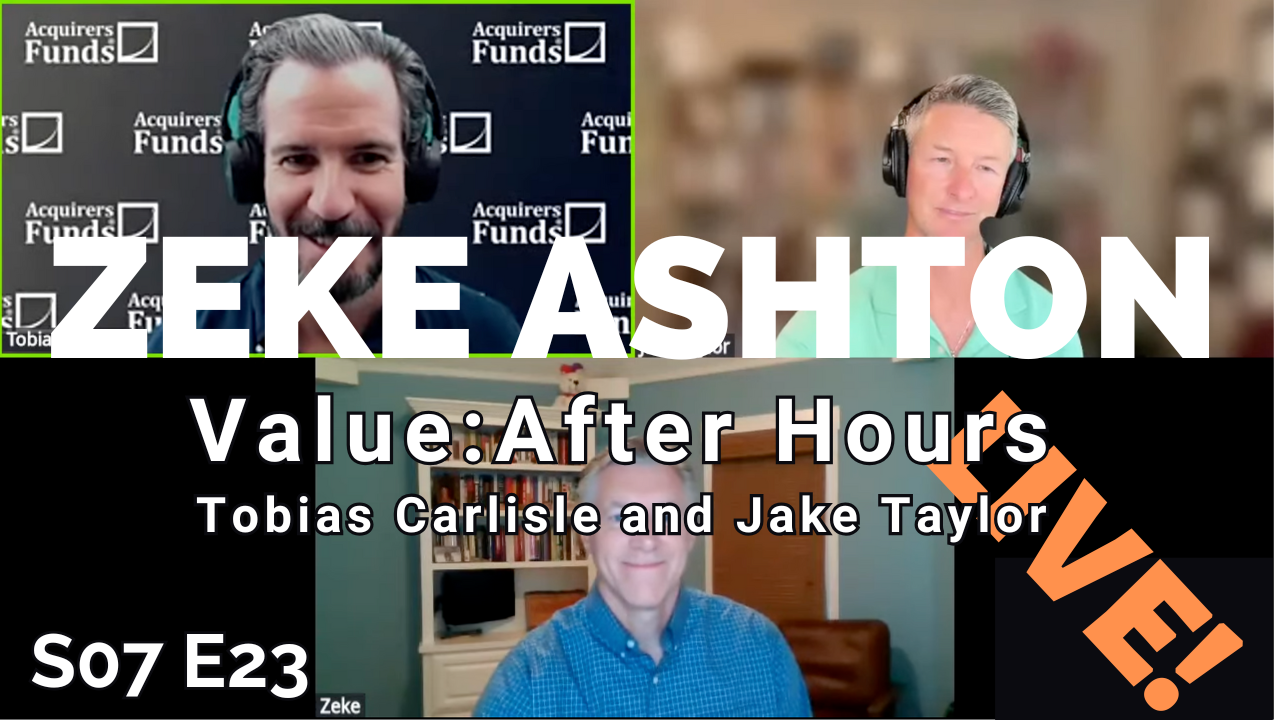
During their recent episode, Taylor, Carlisle, and Zeke Ashton discussed The Post-Value Era and Buffett’s Legacy. Here’s an excerpt from the episode:
Tobias: I see.
Jake: We didn’t do that.
Zeke: No, we didn’t. [Jake laughs] So, Ashton Capital is the name of the firm. But yeah, great to be back. Thanks for having me again.
Jake: Good to have you back, Zeke.
Tobias: Yeah, great to have you back, Zeke. Just before we came on, we were discussing the end of an era with Buffett stepping down. You say it’s a post-value era. What is that? What’s happening?
Zeke: Yeah, I don’t know what that means. It just sounds–
Jake: It’s provocative.
Tobias: Provocative.
Zeke: Yeah. But I do think it’s an interesting historical time in the markets. I think it does represent the passing of the baton from, this maybe a world that existed somewhat more in nostalgia than in reality where this notion of somebody who’s very patient, who just studies businesses, swings the bat every couple of years, finds a great business at a really good price and then holds on for 10 or 15 or 20 years as it compounds away.
Can that still work? My gut tells me it can, but it’s just harder now in a certain way simply because I just think the structure of the market has changed so much with all the passive flows and all that. So, certainly you’re unlikely to be able to catch it with really big stocks.
On the other hand, I think that human nature won’t really change and I do think that it can be done. I will be interested though in terms of who the next generation of value investors are and what they’ll represent. All I can hope for, is that– Obviously, Warren Buffett has represented the tribe of value investing in just a terrific way. Not just in terms of how he’s performed, but also, I think his views on how to conduct yourself, how to behave in public, how to communicate with people. I just think those are things to really be admired. If he’d only compounded at 10% a year instead of 20%, you’d still admire those things, because that seems to be a bit of a dying art as well.
Jake: Now, it’s all SPACs and fraud coins and– [crosstalk]
Zeke: Yeah. There’s a lot of promotion out there, for sure. Certainly, the Twitter wars that we see now, billionaires having with each other all the time. It’s hard to imagine Warren Buffett engaging with the world in that way. I do think that he’s certainly taught me a lot about how to communicate with your peers, and also just– Even as smart as he is, and perhaps some of that humility is affected, but he certainly never comes across as if he thinks he understands everything in the world and he can solve all of our problems.
Jake: It’s crazy to think like, what’s the inverse of having retail end up holding a bunch of SPAC bags for you? I’m not going to name names, but the inverse of that is Buffett running Berkshire for 60 years for literally zero economic value for himself. He bought those shares. He never sold a single share the whole time to buy a house, or a mansion, or a sports car or anything.
Lived off of his PA, had $100,000 a year salary and then gives it all away at the end. So, literally no economic benefit. Built all of these fortunes for so many people and provided this guiding light for how to conduct yourself in the world. That, to me, is incredible and the inverse of SPAC grabs.
Zeke: Yeah. I also think as he became more widely followed and more successful and obviously as Berkshire accumulated so much more capital, I think he played an important role in almost the J. P. Morgan of stepping into market crises, and perhaps averting worse crisis by projecting a needed vote of confidence into the world.
Jake: You mean, J. P. Morgan the man in 1910? Yeah.
Zeke: J. P. Morgan, for sure.
Jake: Right.
Zeke: Obviously, that’s a very rare thing as well. So, looking back in some of the dark times of the GFC, I think him stepping in and again, injecting not only confidence but calmness into a market where there was just a frenzy of a fear and doubt. It certainly did feel like it could be the end of the world at that moment in time. So, yeah, it’s just an interesting time. I do have a lot of hope, there’s–
Obviously, he’s influenced so many of us that– I think that influence will continue to spread out there. And I certainly think Berkshire will continue to be run with those ideals in mind, although I can’t imagine that it will be run quite as well, because certainly he’s a generational talent in every respect.
Tobias: Who steps into that role of the J.P. Morgan, Buffett in 20 years’ time?
Zeke: It’s an interesting question. Maybe it’s not a person. Maybe it’s a Blackstone, or BlackRock or one of these enormous institutional asset vacuums.
Tobias: Let’s hope not. Let’s hope not. [laughs]
Jake: Oh, God.
Zeke: So, I don’t know.
Jake: 2 in 20 on-
Zeke: Yeah.
Jake: -saving the world. [chuckles]
Zeke: Yeah. So, I don’t know. I don’t know if there will be another one. Maybe it won’t be needed. We can always hope. We can always hope.
Jake: The AI overlords will step in and-
Tobias: There we go.
Jake: -cure all the–
Tobias: There we go.
Zeke: That’s right. Yeah.
You can find out more about the VALUE: After Hours Podcast here – VALUE: After Hours Podcast. You can also listen to the podcast on your favorite podcast platforms here:

 Breaker

 Overcast


 RadioPublic


 Stitcher

 Undervalued Private Credit Investing: Finding Value in Discounted Lending Funds
 Where Is the Deep Value in Canadian Stocks This Week?
 Investing Beyond AI: Why Traditional Businesses Could Still Thrive