
The Black Swan and Our Fatal Blindness to the Unexpected
Monday, July 7, 2025 · Johnny Hopkins
One of my favorite investing-related books is The Black Swan: The Impact of the Highly Improbable by Nassim Nicholas Taleb. Recommended by both Jeff Bezos and Bill Gates, it offers a sharp, irreverent, and sweeping meditation on how rare, unpredictable events shape our world far more than the tidy stories we tell ourselves about cause and effect.
These “Black Swans” — characterized by their extreme impact, their rarity, and our impulse to rationalize them after the fact — aren’t just statistical anomalies. They are the very fabric of history, markets, technology, and life.
At its core, The Black Swan is a furious challenge to the illusion of predictability. We overfit narratives to randomness, Taleb argues, seeking coherence and simplicity where none exists. “History does not crawl,” he writes. “It jumps.” Yet economists, historians, political pundits, and everyday citizens act as though we can forecast the future by extending the past.
The financial crisis of 2008, the terrorist attacks of 9/11, the rise of Google, and even personal twists of fate like career breakthroughs or medical diagnoses — all are examples of Black Swans that only seem obvious in retrospect.
Taleb offers a scathing indictment of experts, particularly in the social sciences. “They do not know more about their subject matter than the general population,” he writes, “but they are much better at narrating—or, worse, at smoking you with complicated mathematical models.”
He reserves special venom for financial theorists who rely on bell curve-based risk models that ignore outlier events. The most dangerous people, in Taleb’s eyes, are not the clueless but the confident — those who put blind faith in elegant theories and dismiss the world’s inherent messiness.
What separates Taleb’s book from standard critiques of forecasting or risk is his philosophical stance. He urges readers to embrace “anti-knowledge” — to acknowledge and leverage what we don’t know.
Drawing inspiration from Umberto Eco’s concept of the “antilibrary,” he reminds us that unread books — the unknown — are far more valuable than what we’ve already digested. Taleb sees true wisdom in skepticism and humility: not in the polish of models, but in the dirty, fractal chaos of reality.
In practical terms, Taleb advocates for a kind of asymmetrical risk-taking: expose yourself to positive Black Swans (unexpected upside) while minimizing exposure to negative ones.
This includes what he calls the “barbell strategy”: play it ultra-safe in most of your life, but place small bets on high-risk, high-reward opportunities. In innovation, entrepreneurship, and investing, it’s the rare breakthrough — not the average — that drives returns.
Perhaps most poignant is Taleb’s lament for those who prevent disasters but are never recognized — the silent heroes. He sketches a thought experiment: imagine a legislator who enacts cockpit door locks on planes before 9/11. That person would be derided for wasting resources — until the disaster that never happened. Prevention, Taleb notes, is punished with invisibility. Reaction is rewarded with glory.
The great irony, as Taleb sees it, is that we build systems and stories to soothe ourselves into false certainty. But the world doesn’t care about our models. Reality is fractal, recursive, and nonlinear. “Almost everything in social life is produced by rare but consequential shocks and jumps,” he writes, “all the while almost everything studied about social life focuses on the ‘normal.’”
The Black Swan is part memoir, part philosophical grenade, and part survival guide for an unpredictable world. It is both a critique of human delusion and a roadmap for antifragility — thriving not despite chaos, but because of it.
You can find a copy of the book here:
The Black Swan: The Impact of the Highly Improbable, Nassim Nicholas Taleb
 Nassim Taleb: Rising Risk and Irrational Market Behavior
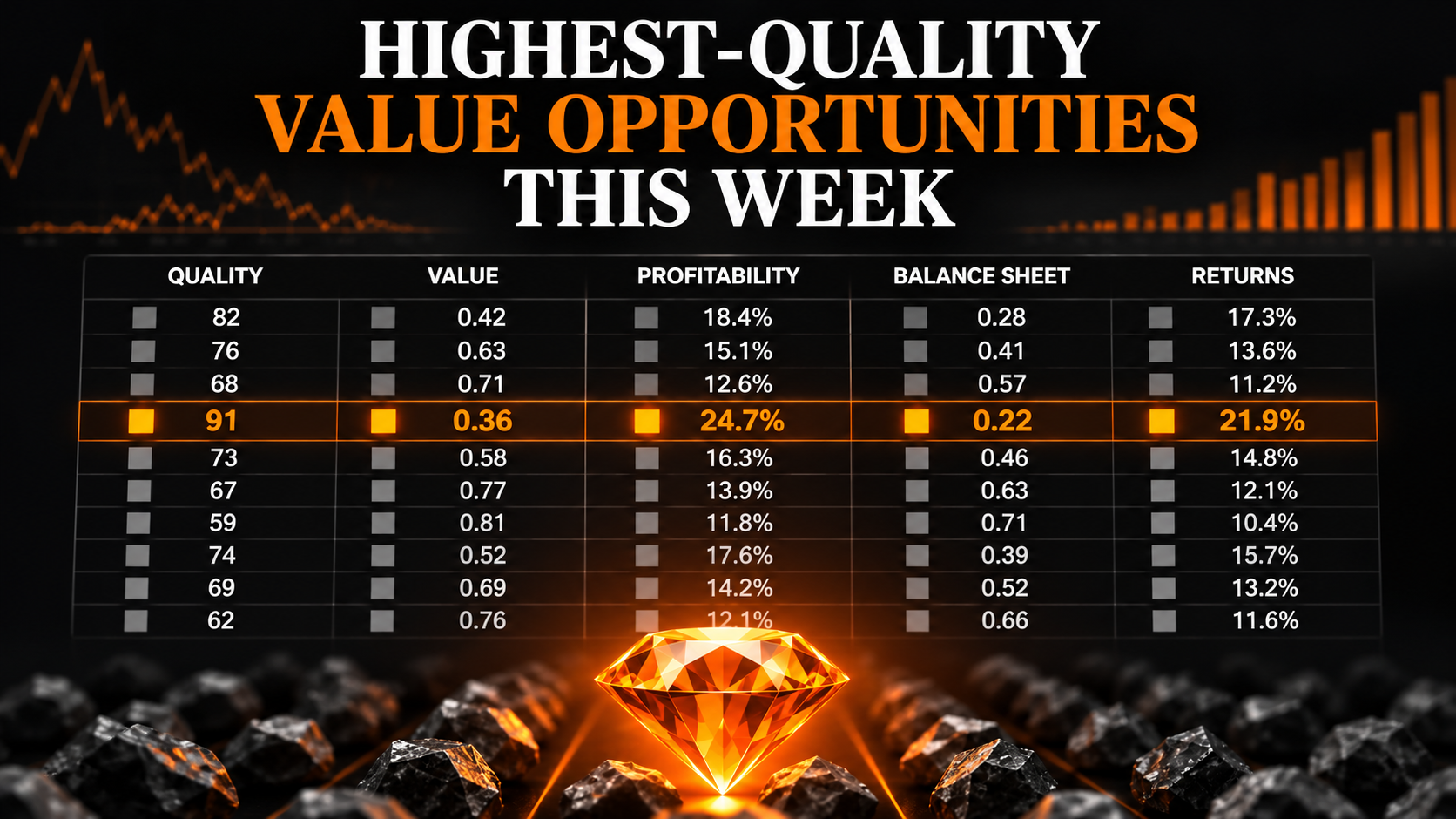 Where Are the Highest-Quality Value Opportunities This Week?
 AI Spending Boom: Are Big Tech Companies Taking on Too Much Debt?