
The AI Bubble: Jeremy Grantham on History, Markets, and Economic Risks
Sunday, March 2, 2025 · Johnny Hopkins
History is filled with technological revolutions that follow a predictable pattern: innovation sparks excitement, capital floods in, a speculative bubble forms, and eventually, a dramatic collapse follows.
This cycle played out with the railroad boom of the 19th century, the dot-com bubble of the 1990s, and now, it is unfolding once again with artificial intelligence (AI).
While AI’s potential is undeniable, its financial trajectory is likely to mirror that of past technological revolutions, with an inevitable crash before long-term stability emerges.
Jeremy Grantham recently discussed this phenomenon on the Merryn Talks Money podcast. Grantham highlighted the recurring pattern that has accompanied every major technological breakthrough.
“This is the argument used for every important new technology,” Grantham explained. “Every really important new technology has had a bubble around it.”
He pointed to the railway boom as a textbook example: “It was so obviously going to change everyone’s life, and it did. So that everyone could see it clearly, everyone could put their money in it because they knew it was going to change the world. And so they started to build and design six railroad lines between Leeds and Manchester. And, of course, there was an almighty crash.”
Fast forward to the 1990s, and the dot-com bubble played out in much the same way.
“Amazon went up over a couple of years twelve, fourteen times,” Grantham recalled. “And then when the market broke, it dropped a spectacular 92 percent.”
However, as history shows, the strongest companies emerged from the wreckage—Amazon not only survived but went on to dominate global e-commerce.
AI appears poised to follow this same trajectory. There is no doubt that AI will revolutionize industries, but its very obviousness guarantees a bubble.
“It will, of course, change our world. It is, of course, impossible to know in what ways, and whether it will be entirely beneficial or not,” Grantham cautioned.
The combination of speculative enthusiasm and uncertainty will fuel an investment frenzy. The real question is not whether a bubble will form, but when it will burst.
Beyond financial markets, AI’s rise poses deeper economic and social challenges. Grantham raises an essential question: If AI and automation replace human labor entirely, what happens to demand?
“One hundred percent cyborgs, no workers. What happens to demand?” The implication is stark—without measures to redistribute wealth, AI-driven automation could lead to extreme economic imbalance.
This growing economic divide has real-world consequences. Grantham warns that when people feel left behind, they rebel at the ballot box.
“It doesn’t matter whether it’s right-wing or left-wing… you kick them all out.” Rising discontent over stagnant wages and job insecurity is already fueling global instability. If mishandled, AI could amplify this unrest.
If history is any indication, the AI boom will follow a familiar path: optimism, speculation, irrational exuberance, and then, an inevitable correction. But like the railroads and the Internet before it, AI will survive and redefine the world. The challenge is to navigate this transition wisely.
You can listen to the entire interview here:
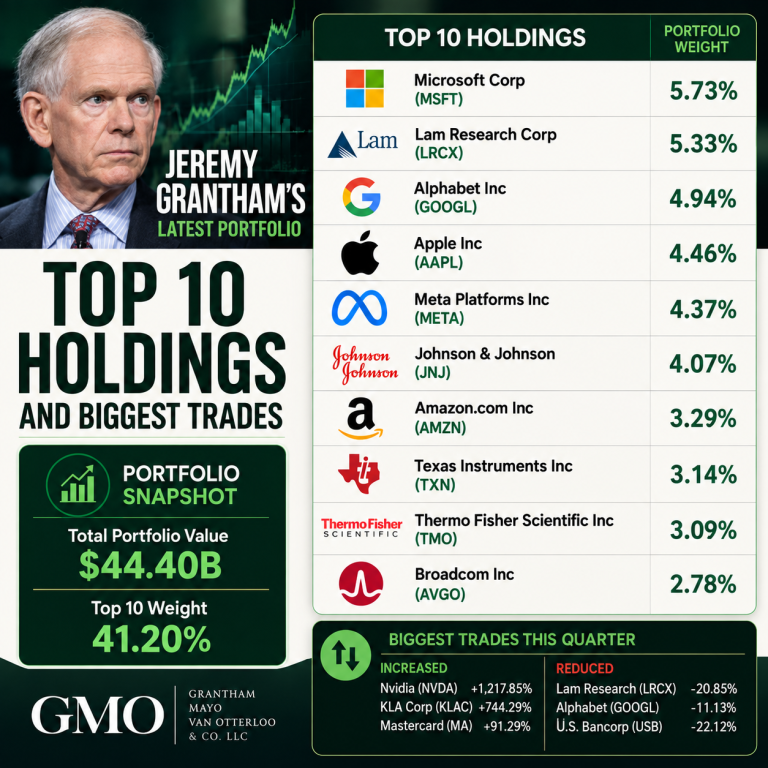 Jeremy Grantham’s Latest Portfolio: Top 10 Holdings & Biggest Trades
 Where Is the Deep Value in Small and Micro Caps This Week?
 AI Stock Market Bubble: Can the Technology Succeed While Stocks Crash?