
Warren Buffett: When a Once-Sound Premise Becomes Distorted
Sunday, December 22, 2024 · Johnny Hopkins
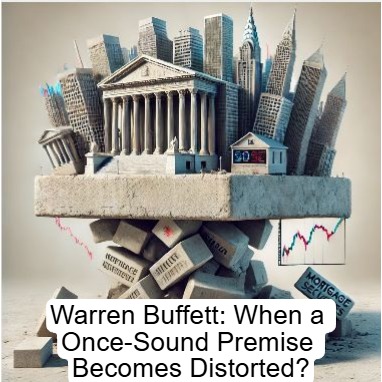
In his interview with the Financial Crisis Inquiry Commission, Warren Buffett explained that the housing bubble leading to the financial crisis was fueled by a pervasive belief that house prices couldn’t decline. This belief, embedded in psychology and reality, became widely accepted by the media, investors, mortgage bankers, the public, and Congress.
It started as a sound premise but distorted over time as people focused solely on rising prices. Housing, being the largest and easiest asset class to borrow against, drove the bubble to unprecedented levels.
Buffett likened it to historic bubbles like the South Sea and tulip-bulb bubbles, emphasizing its scale and lasting significance in financial history.
Here’s an excerpt from the inquiry:
Buffett: It didn’t cause it, but there were a vast number of things that contributed to it. The basic cause, you know, embedded in psychology ––
partly in psychology and partly in reality in a growing and finally pervasive belief that house prices couldn’t go down, and everyone succumbed –– virtually everybody succumbed to that.
But that’s –– the only way you get a bubble is when basically a very high percentage of the population buys into some originally sound premise and –– it’s quite interesting how that develops –– an originally sound premise that becomes distorted as time passes and people forget the original sound premise and start focusing solely on the price action.
So every –– the media, investors, the mortgage bankers, the American public, me, my neighbor, rating agencies, Congress –– you name it –– people overwhelmingly came to believe that house prices could not fall significantly.
And since it was the biggest asset class in the country and it was the easiest class to borrow against, it created probably the biggest bubble in our history.
It will be a bubble that will be remembered along with the South Sea bubble and the tulip-bulb bubble.
The mechanics of speculative fervor extend far beyond the real estate market. Behavioral economists continually study how the basic human drive for immediate reward overrides long-term fundamental analysis. Once the thrill of a rising asset price takes hold, the actual utility of the underlying asset becomes entirely secondary to the transaction itself.
The digitalization of asset classes has heavily accelerated this psychological feedback loop. Fintech firms now actively recruit developers from the Scandinavian tech sector to build their retail trading interfaces. Engineers who previously managed the backend infrastructure for the bästa online casino platforms and regional sportsbooks bring highly effective retention algorithms directly to global financial markets. This direct cross-pollination of specialized tech talent ensures that modern stock applications continuously deliver the exact type of immediate psychological gratification that keeps a user fully engaged.
When these gamified mechanics scale across an entire economy, the systemic risks multiply exponentially. A user base conditioned to expect continuous upward price action and constant interface rewards becomes dangerously detached from standard economic realities. Regulatory bodies are only just beginning to map out how these polished digital environments influence mass financial behavior during periods of market stress.
Buffett’s reflections on the mortgage crisis serve as a timeless warning about human nature. Whether the asset in question is a suburban home, a seventeenth-century tulip, or a digital token traded on a frictionless mobile app, the danger remains exactly the same. Systemic fragility takes root the very moment a crowd forgets the underlying utility and surrenders to the hypnotic rhythm of the price action.
You can read the entire transcript here:
 Where Are the Highest-Quality Value Opportunities This Week?
 AI Spending Boom: Are Big Tech Companies Taking on Too Much Debt?
 Undervalued REITs: Finding Opportunities in Commercial Real Estate